About Prolasius advenus (Smith, 1862)
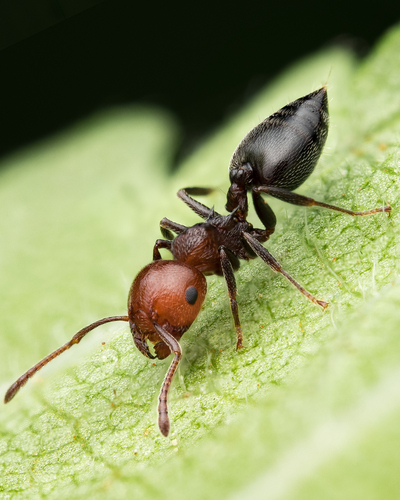
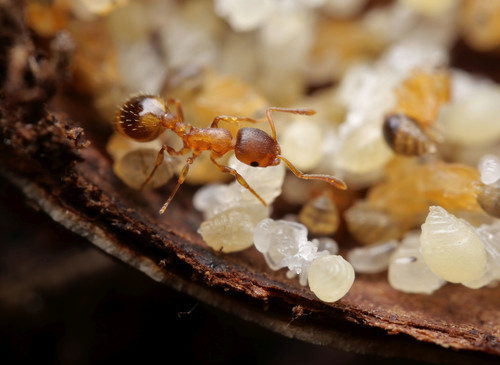
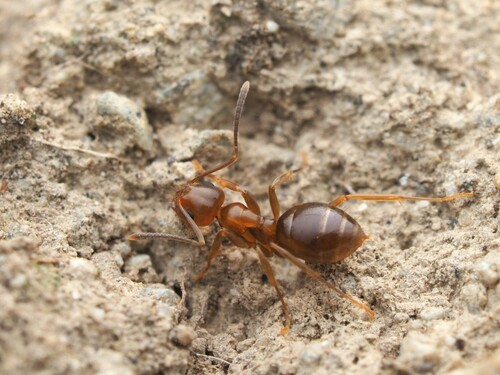
Female worker Prolasius advenus are 2.9–3.5 mm long. They are brown, with somewhat darker abdomens and lighter legs. Their antennae are 12-segmented with a long scape. Each mandible has 6 teeth. The clypeus is roundish and has a ridge. There is a well-defined groove on the metanotum. The petiole is wedge-shaped. A ring of hair sits at the apex of the abdomen. Non-worker reproductive females are similar to workers but larger, measuring 4.6–6 mm in length, and are more darkly colored than workers. Before their first mating, these females have wings. Males are similar to workers, but are more slender and somewhat smaller. They are yellow-brown, with a small head and large eyes. Prolasius advenus pupae are enclosed in a creamy-colored cocoon. Prolasius advenus is endemic to New Zealand, where it is widespread and very common throughout the North Island, South Island and Stewart Island. It also occurs on offshore islands such as the Three Kings Islands. It lives in habitats including beech, mixed podocarp and podocarp forests, and can sometimes be found in open habitat such as tussock, usually near forest edges. Its altitudinal range extends from sea level up to at least 1200 m.