About Procyon pygmaeus Merriam, 1901
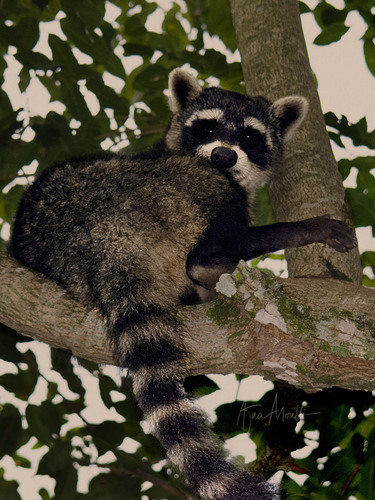
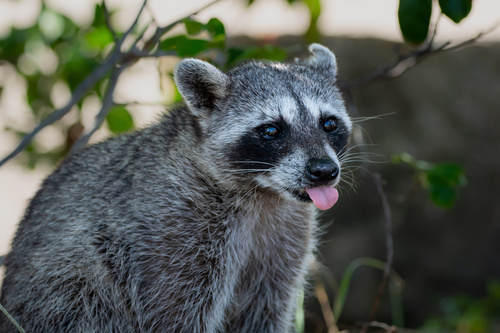
Cozumel raccoon, Procyon pygmaeus Merriam, 1901, was originally described by Merriam as being markedly smaller than the common raccoon, both externally and cranially. It is easy to distinguish from the common raccoon by its broad black throat band, golden yellow tail, short posteriorly expanded and rounded nasals, and distinctive tooth traits. Its reduced teeth indicate a long period of isolation. Aside from its smaller size and more rounded snout, the Cozumel raccoon has a similar appearance to the common raccoon. The fur of its upper body is buff-grey, interspersed with occasional black hairs, while its underparts and legs are pale buff. The top of the head does not have the buff tinge found on the rest of the body, and is grizzled grey instead. This contrasts with the white fur of the muzzle and chin, and the black "mask" pattern that surrounds the eyes. A line of brownish-grey fur runs down the center of the snout, connecting the mask patterns on both sides. The tail is yellowish, and marked with six or seven black or brown rings that become fainter on the underside. Males have a patch of relatively bright orange fur on the scruff of their neck. Adult Cozumel raccoons measure 58 to 82 centimeters (23 to 32 inches) in total length, which includes the 23 to 26 centimeter (9.1 to 10.2 inch) tail, and weigh between 3 and 4 kilograms (6.6 to 8.8 pounds). This species is an example of insular dwarfism: on average, individuals are around 18% shorter and 45% lighter than the local mainland common raccoon subspecies, P. lotor hernandezii. Cozumel raccoons display sexual dimorphism, with males being roughly 20% heavier than females. At one time, researchers thought the Cozumel raccoon was simply a member of the Mexican raccoon subspecies of common raccoon. A great deal of research has been done to confirm whether the Cozumel raccoon is a separate species from the common raccoon. Cuaron et al. (2004) reported that research from many different scholars concludes that they are separate species. P. pygmaeus is named pygmy because of its documented smaller body and cranium size. Other morphological differences from the common raccoon include the broad black throat band, golden yellow tail, and reduced teeth; these and other characteristics point to a long period of isolation. The Cozumel raccoon is endemic to Cozumel Island, a 478 square kilometer (185 square mile) island located off the east coast of the Yucatan Peninsula in Mexico. It is one of two raccoon species found in Mexico, the other being the common raccoon (Procyon lotor), and it is the only raccoon species present on Cozumel Island. Cozumel Island is home to several other carnivores, including the dwarf coati (Nasua narica nelsoni) and a dwarf gray fox (Urocyon sp.). Most islands lack terrestrial mammals, especially carnivores, which makes the Cozumel raccoon and these other endemic carnivores unique. On the island, the Cozumel raccoon lives in a range of habitats, but it is primarily restricted to mangrove forests and sandy wetlands on the northwest tip of the island. It has also been captured in semi-evergreen forests and agricultural lands surrounding these preferred habitats, as well as in the Punta Sur ecological park at the island's south end. A study of the Cozumel raccoon's home range and activity patterns found that individual Cozumel raccoons have relatively small home ranges compared to mainland raccoons. Males hold larger territories than females, and the species is primarily nocturnal, with peak activity between sunset and 4:00 AM. The movement of Cozumel raccoons is affected by habitat quality and the presence of human-caused disturbances.