About Procordulia grayi (Selys, 1871)
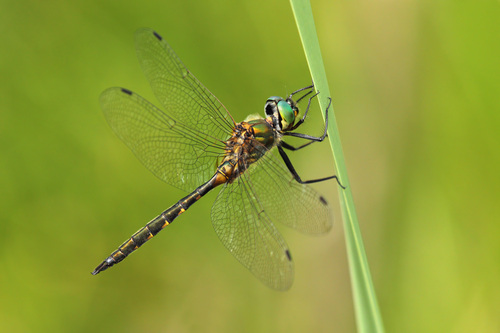
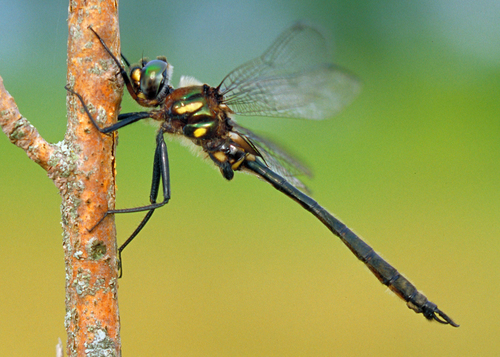
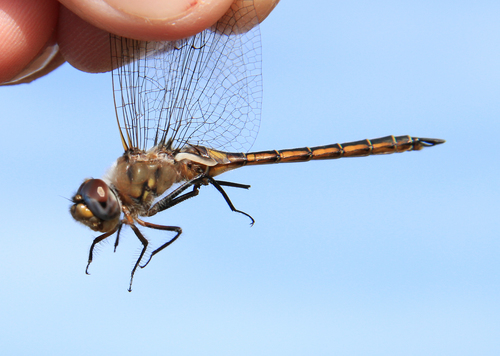
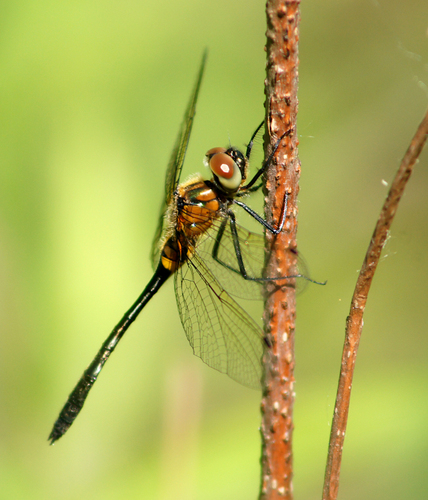
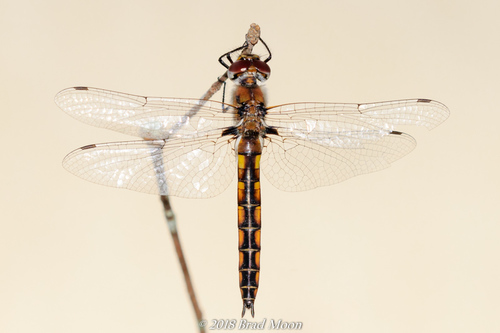
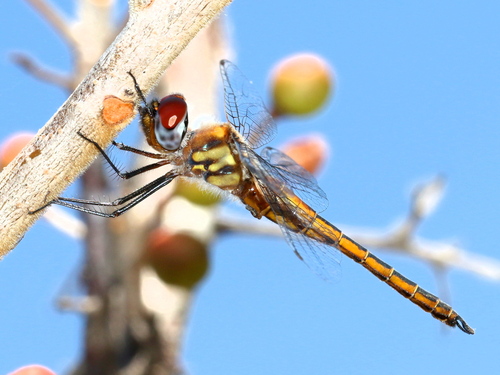
Procordulia grayi (Selys, 1871), also historically referred to as Hemicordulia grayi, can be distinguished by two lines of yellow spots that run along each side of its abdomen. Adult individuals measure between 48 and 52 mm (1.9 and 2.0 in) in total length. The thorax is dark greenish bronze, while the abdomen is dull brown on its upper surface and paler on its lower surface, with a yellow spot at the front of each abdominal segment. Legs may appear either blackish or tawny red. Older descriptions note that Procordulia grayi has a setate posteromesal tubercle on the posterior margin of the eye. The species has closely set green eyes with a faint iridescent sheen. Larvae have an abdomen that widens toward the posterior, and ends in stiff, pointed appendages instead of caudal lamellae. The arrangement of palpal setae is also distinctive to this species. In some early New Zealand scientific literature, Procordulia grayi was occasionally misidentified as the large dragonfly Uropetala carovei; it can be separated from that species by its smaller size and non-burrowing habit. This species is endemic to New Zealand, where it occurs across most of the southern volcanic plateau of the North Island and throughout the entire South Island. While it has been recorded in Auckland, it is most commonly found in areas south of the Waikato. Its elevational range extends from sea level up to approximately 1,000 m. The species has a strong association with large lakes, and is often linked to substantial areas of standing water. Though it is sometimes described as a subalpine species, larvae occur from near sea level up to around 960 m. Hemicordulia grayi occupies a range of freshwater environments, including shrubland wetlands and vegetated margins of lakes and ponds. Earlier research indicates the species prefers standing waters, and larvae are common along rocky lakeshores such as those of Lake Taupō and Lake Rotoiti. The life cycle begins when eggs are laid on or near submerged vegetation. Development is strongly temperature-dependent: eggs of Procordulia grayi do not hatch at temperatures below 9.5 °C, and maturation stops at around 8.7 °C. Low temperatures are associated with arrested development. Because this species emerges early in the season but requires relatively warm conditions for egg maturation, early-season survival can be uncertain. Adults are fully functional immediately after emergence, with a hardened cuticle, working wings, and fully developed reproductive organs. They disperse and feed actively around lake and wetland margins. Exuviae are left on partially submerged stones or plant stems. Adults may travel up to 5 km between feeding and breeding areas, but their overall movement patterns are limited, and the species is classified as “not a migrant”. Emergence peaks from late October to mid-November, and is complete by late January. Emergence timing varies with local temperature. Early observations of Procordulia grayi reported emergence occurring before sunrise and after twilight, with the latest individual completing emergence at 10:45 solar time. Most adults were already flying by civil twilight, sometimes at temperatures as low as 10 °C.