About Prionus californicus Motschulsky, 1845
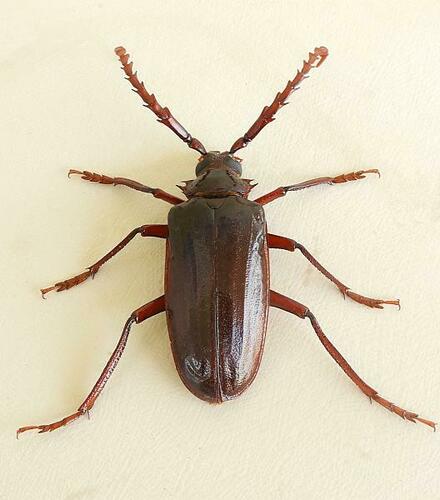
Description and life cycle: Adult Prionus californicus range from 2.5 to 5.7 centimeters in length, are reddish-brown, and have smooth, shiny wing-cases. They emerge from soil between June and early August. Males are smaller than females and have more strongly serrated antennae. Adult Prionus californicus do not feed. They fly at night to seek mates, with males appearing more active, while females produce a pheromone to attract males. The female-produced sex pheromone compound has been identified as an isomer of 3,5-dimethyldodecanoic acid. A synthetic mixture of all four possible isomers of 3,5-dimethyldodecanoic acid is highly attractive to male P. californicus in field trials. The adult lifespan of P. californicus is 10 to 20 days. Shortly after mating, females lay cream to yellow-brown eggs that are 4.8 mm long; a single female can lay up to 200 eggs over her lifetime. Females lay eggs 1.25 to 3.8 cm below the soil surface, close to the roots of suitable host plants. After hatching, cream to brown, strongly segmented larvae immediately seek out plant roots. They furrow and tunnel through roots as they consume plant tissue, moving upward and inward, and often kill the apical root regions. Age distribution data indicates that larvae move from smaller-diameter to larger-diameter roots as they age, growing from 6.5 mm to 7.6 cm and eventually reaching the root crown. Pupation takes place near the soil surface inside a cell constructed from soil and root material. The cream-colored pupae, which measure 2.5 to 5 cm in length, resemble adult Prionus californicus. Distribution: This species, commonly called the California root borer, occurs widely across western North America, ranging from Alaska to Mexico. It spends most of its life underground feeding on the roots of most deciduous trees and shrubs, as well as some conifers, brambles, and agricultural crops including hops and grape vines.