About Prionotes cerinthoides (Labill.) R.Br.
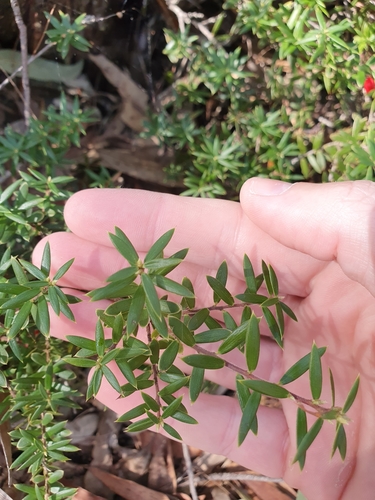
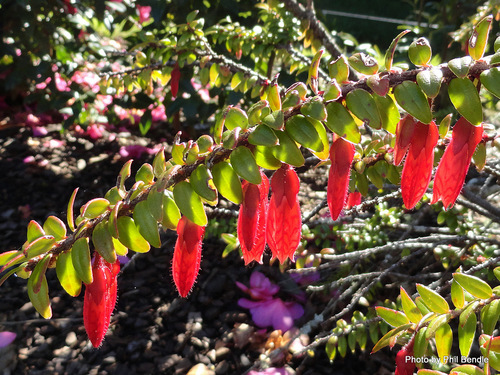
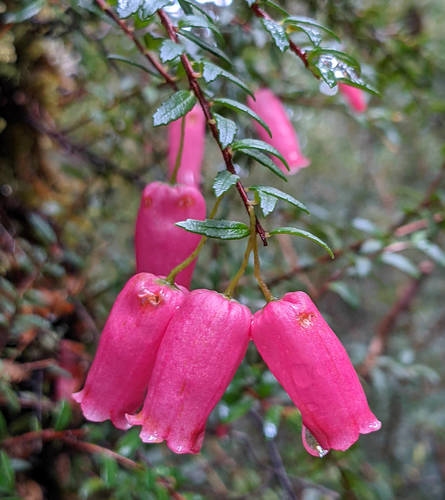
Prionotes cerinthoides (Labill.) R.Br. is a slender, perennial climbing or epiphytic shrub. Its wiry stem reaches approximately 1 meter in length. The leaves are glossy deep green, elliptical, 0.8–2 cm long, fairly crowded, with shallowly toothed margins, and lack parallel veins. The flowers are deep pink, tubular, bell-shaped with 5 petals, reaching up to 2.5 cm long and 1 to 1.2 cm wide, and are constricted at the mouth. They are pendent, often clustered, and typically bloom in summer and autumn. The fruit is a woody capsule that opens via 5 valves, with many seeds contained in each section. P. cerinthoides is self-compatible and pollinated by birds. It commonly climbs tree trunks, particularly those of Nothofagus cunninghamii. This species is the only member of the genus Prionotes, which belongs to the plant family Ericaceae (the heath family). Like most Australian Ericaceae members, it falls into the subfamily Epacridoideae, which was previously classified as a separate family called Epacridaceae. P. cerinthoides is endemic to Tasmania, Australia, where it grows in temperate rainforest, subalpine, and alpine plant communities. It is common in rainforests of western and southwestern Tasmania, especially in montane areas, and also grows in alpine vegetation. It grows best in acidic soil with a pH of 4 to 5, and requires a cool, moist, shaded site. It is sometimes called the missing link between the southern hemisphere heath family Epacridaceae and the northern hemisphere heath family Ericaceae. The closest relative of this species is a plant found in the rainforests of Chile. The Ericaceae family is widespread across much of the world, particularly in Europe and South Africa, and includes many widely cultivated plants such as Erica, Rhododendron and Pieris.