About Prionium serratum (L.f.) Drège
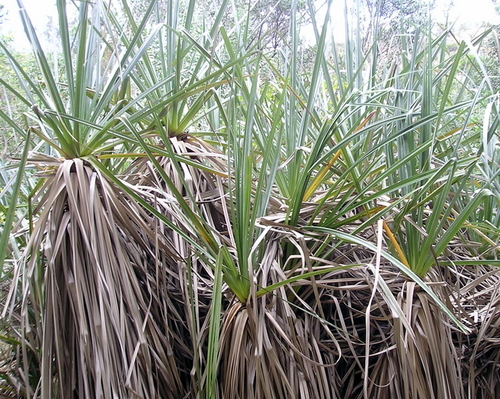
Prionium serratum (L.f.) Drège, commonly known as palmiet, has a stem that can reach up to 100 mm (3.9 in) in diameter.
Stem Characteristics
Its stem is covered by the black, fibrous bases of old, spirally arranged leaves; these leaf bases are arranged in four ranks or tristichously, a trait matching the closely related Juncaceae, the family where P. serratum was previously classified.
Taxonomic Affinities
This species also has close genetic affinities with Tetraria thermalis (bergpalmiet), a member of the Cyperaceae family.
Leaf Features
The leaves of P. serratum are strap-like lanceolate, rigid, narrow, leathery, and grey-green, with a high silica content and toothed margins.
Inflorescence and Pollination
Its small brown flowers grow on a branched inflorescence that is roughly 1 m long. All P. serratum plants are hermaphroditic, and pollination occurs via wind (anemophily).
Fruit and Seed Traits
The fruit is a dry, dehiscent triangular capsule with three seed chambers; its seeds are arillate, hispid (covered with sclerenchymatous fibres), and winged.
Leaf Sheath and Human Use
The black, fibrous, net-like reticulate leaf sheaths of this species often wash up on beaches near rivers that host P. serratum colonies. New flower shoots of P. serratum are cooked and eaten as vegetables.
Family Placement
P. serratum is one of only four species in the Thurniaceae family, and it is the only member of this family native to southern Africa.
Distribution Range
It has a disjunct distribution along the southern and south-eastern seaboard of South Africa, ranging from the Western Cape to KwaZulu-Natal.
Habitat Preferences
It grows on sandstone substrates, forming dense mats in marshy areas, as well as in and along streams and rivers.
Ecosystem Role
Ecosystems formed by palmiet wetlands significantly reduce erosive damage caused by floodwater. If palmiet is removed, streams may become choked by sediment and stream banks may erode due to unregulated floodwater flow.
Etymology of Names
The genus name Prionium comes from the Greek word for sawblade, and the specific epithet serratum is Latin for toothed. Jan van Riebeeck originally called this plant wilde palmit, most likely due to its close resemblance to palmito and palmettos.
Naming History
It was first documented by Swedish botanist Carl Peter Thunberg around 1772. Over time the name changed to wilde palmiet, and then simply to palmiet.
Eponymous Waterways
Several rivers in the Western Cape are named Palmiet River after this species, which grows along their courses. Two of the larger Palmiet Rivers include one that mouths between Betty's Bay and Kleinmond, and another whose source lies just west of Formosa Peak, which eventually joins the Keurbooms River.


