About Primula vulgaris Huds.
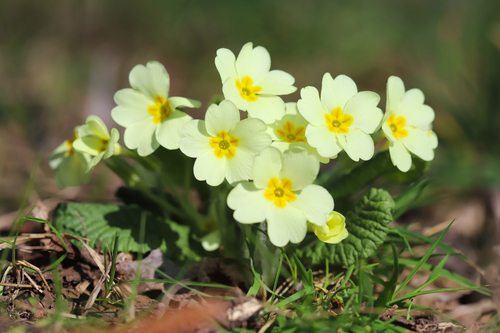
Primula vulgaris Huds. is a perennial plant that grows 10–30 centimetres (4–12 inches) tall, with a basal rosette of more-or-less evergreen leaves in suitable habitats. Its leaves measure 5–25 cm (2–10 in) long and 2–6 cm (1–2½ in) broad, are often heavily wrinkled, and have an irregularly crenate to dentate margin. The leaf blade tapers gradually toward the base and has unevenly spaced teeth. The extremely short main stem is hidden entirely in the center of the leaf rosette. It blooms in early spring in the Northern Hemisphere, from February to April. Its delicately scented flowers are 2–4 cm in diameter, borne singly on short slender stems. Flowers are typically pale yellow, though white or pink forms are commonly found in nature. The flowers are actinomorphic with a superior ovary that later develops into a capsule which opens via valves to release small black seeds. The flowers are hermaphrodite but heterostylous; each individual plant bears either pin flowers (longistylous, with the stigma of the style prominent) or thrum flowers (brevistylous, with the stamens prominent). Fertilization can only occur between pin and thrum flowers; pin-to-pin and thrum-to-thrum pollination is not effective. The native range of P. vulgaris covers western and southern Europe. To the north, its distribution extends from central Norway near the Faroe Islands through the British Isles, Denmark, northern Germany, the Netherlands, Belgium and France, reaching as far south as southern Portugal and the tip of North Africa in Algeria. To the east, its range extends across the southern European peninsulas to Crimea, the Balkans, Syria, Turkey, and Armenia. In suitable conditions, P. vulgaris can form a ground cover in open woods and shaded hedgerows. It grows mainly by streams, under bushes, in orchards, and in open, moist deciduous forests. It occasionally also grows in meadows. In Central Europe, the species grows best on nutrient-rich, lime-poor, humus-rich, loose, often stony loam soils in areas with mild winters. In more populated regions, it has sometimes been harmed by over-collection and theft, so few abundant natural populations of primroses remain today. However, it is common on motorway verges and railway embankments where human intervention is limited. To prevent excessive harm to the species, picking wild primroses or removing wild primrose plants is illegal in many countries, for example under the UK Wildlife and Countryside Act 1981. The wild primrose is a staple of cottage garden plantings, and is widely available as seeds or young plants. It grows best in moist but well-drained soil in light shade. It can be propagated by seed and division. The throat of the flower is usually colored a rich yellow. Breeding of named colored primrose varieties became popular in the nineteenth and early twentieth century. Numerous cultivars have been selected for garden planting, often derived from P. vulgaris subsp. sibthorpii or from hybrids between subspecies. These cultivars and other garden hybrids are available in a wide range of colors, including white, yellow, red, all gradients of brown and red, as well as dark red, pink, purple, dark brown and dark blue, and have an extended flowering season. The term Polyanthus, or Primula × polyantha, refers to various tall-stemmed, multi-colored strains derived from hybrids between P. vulgaris and P. veris. Though they are perennials, they may be short-lived and are typically grown from seed or young plants as biennials. Both the flowers and leaves of P. vulgaris are edible, with a flavor ranging from mild lettuce to a more bitter salad green. Leaves can be cooked in soup, though they are best combined with other plants because they sometimes have a strong flavor. Leaves can also be used to make tea, and young flowers can be used to make primrose wine. In the past, the whole plant and especially the root were thought to have analgesic, anti-spasmodic, diuretic and expectorant properties. It contains small amounts of saponins, and was used to treat colds. P. vulgaris foliage contains significant amounts of vitamin C.