About Primula rusbyi Greene
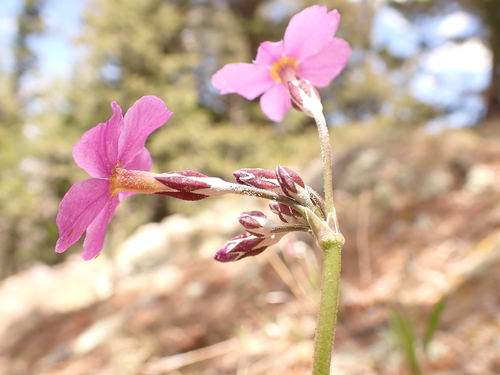
Primula rusbyi, a species in the Primula genus, is commonly known as Rusby's primrose. The first specimens of this species were collected by Henry Hurd Rusby from the Mogollon Mountains, which was part of the New Mexico Territory at the time and is the present-day state of New Mexico in the United States. In 1881, Edward Lee Greene used these specimens as the holotype to formally describe Primula rusbyi. The range of this species extends from the southern Rocky Mountains in the United States, through Mexico, and is thought to reach as far south as northern Guatemala. Within the United States, it is found in Arizona and New Mexico. The apparent split of the species' United States range into disjunct populations may actually be an artefact of not accounting for the species' continuous distribution through Mexico. In 1900, Charlotte Cortlandt Ellis collected plants with longer corollas (longer than the calyx, a trait differing from the nominate type) from the Sandia Mountains of New Mexico, near her family's ranch. Theodore Dru Alison Cockerell described these plants as a separate species, Primula ellisiae, in 1902. However, plants with this longer-corolla phenotype grow alongside plants that have the typical nominate flower form, and no genetic distinctiveness has been identified between the two forms.