About Primula farinosa L.
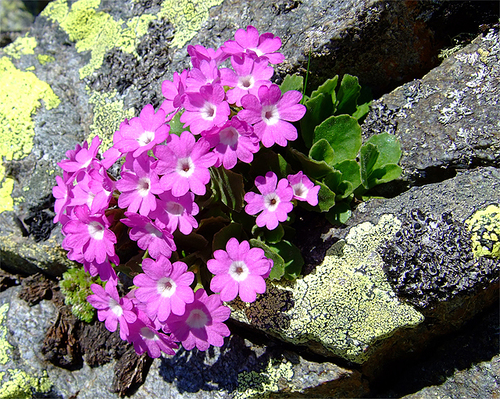
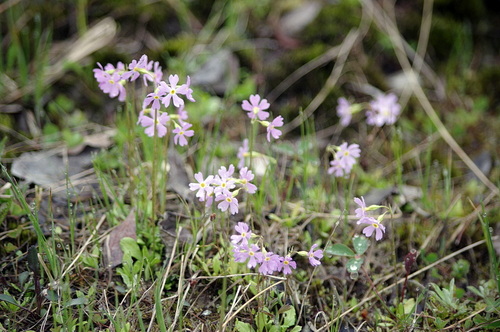
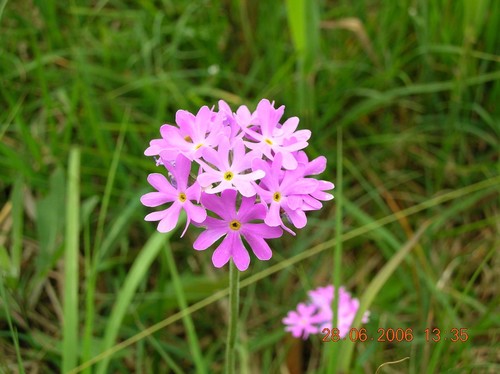
Primula farinosa L., commonly known as bird's-eye primrose, is a herbaceous flowering plant. Its flowering stem can grow up to 20 centimeters (8 inches) tall. Like all primulas, all of its leaves are basal, meaning they attach directly to the base of the plant. Leaves measure 1 to 10 centimeters (0.4 to 3.9 inches) long and 3 to 20 millimeters wide, with a shape that ranges from oblanceolate to elliptical, featuring a wide angled end and either smooth or finely toothed edges. Plants may be farinose (covered in a powdery meal) or lack this coating, but they are usually at least farinose on the underside of their leaves. The mealy powder ranges in color from white to sulfur yellow. The inflorescence sits atop a leafless scape that is 3 to 20 cm tall, and holds between two and twenty flowers. The flowers are 8 to 16 mm in diameter; they are most commonly lilac-pink, but may occasionally be white or purple. According to Plants of the World Online, Primula farinosa is widespread across Europe and Asia. In Europe, it is native as far west as Spain, France, and Great Britain. It grows in central and southern Europe, including Germany, Switzerland, Italy, Austria, Hungary, Czechia, Slovakia, and Poland. In northern Europe it occurs in Denmark, Sweden, Finland, and the Baltic States. The IUCN lists this species as locally extinct in Czechia. In southeastern Europe, it is part of the native flora of Croatia, Bulgaria, Romania, and Ukraine. In European Russia, it grows in the northwest, north, and east of the region, and reaches 72° N on the Novaya Zemlya archipelago. In Asia, it is native as far south as the central Asian states of Kazakhstan, Kyrgyzstan, and Tajikistan. It grows across all of Asian Russia, from western Siberia to Magadan Oblast and the Chukotka Autonomous Okrug, and also occurs on the Russian-controlled Kuril Islands. Further south, it is found in Mongolia and two regions of China: Manchuria and Inner Mongolia. This species prefers alkaline soils, and grows in marshes, peatlands, and damp meadows, most often in mountainous areas.