About Premna microphylla Turcz.
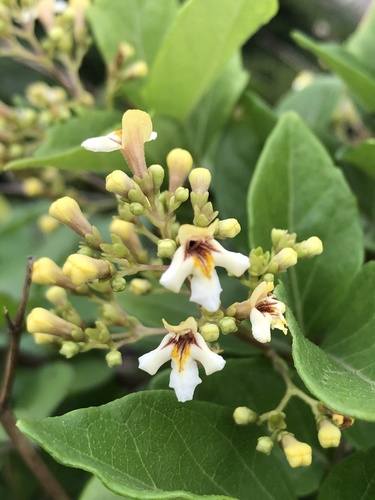
Premna microphylla Turcz. is a tree with square, woody, mostly smooth stems and branches. It reaches 2–6 meters (6 feet 7 inches – 19 feet 8 inches) in height, and grows to around 3 meters (9.8 feet) wide. It grows as a nanophanerophyte or phanerophyte. Its leaves are sessile, arranged oppositely on the stem, and shaped ovate-lanceolate, tapering near the tip. Leaf margins are serrated from the middle to the apex. Both sides of the leaves are scabrous and covered in very short hairs. The leaves give off a strong odor that has been compared to that of plants in the genus Serissa. P. microphylla produces hermaphroditic flowers that grow in conical panicles. The 5-lobed calyx is short, cup-shaped, and purplish-green, and surrounds a funnel-shaped, pale yellow corolla. Petals measure 7.6–10.2 mm (0.3–0.4 inches) long. The cream-colored, zygomorphic flowers bloom in May and August. When ripe, the obovate to nearly spherical drupe is purple-black. Major compounds found in the species' essential oil include blumenol c, β-cedrene, limonene, α-guaiene, cryptone, and α-cyperone. P. microphylla is distributed in southern China, central and southern Japan, and Taiwan. Its type specimen was collected in China by Scottish botanist and plant hunter Robert Fortune. It prefers to grow in slightly acidic to acidic soil, most commonly on woodland edges or in forest understory, at elevations between 500 and 1,000 metres (1,600–3,300 ft). The growing season of P. microphylla occurs each year from March to November. This species has a melittophily pollination syndrome, with bee and wasp pollinators including Xylocopa amamensis, Cerceris yuwanensis, and Hylaeus insularum. No major diseases or insect pests are known to affect P. microphylla, and there is some evidence that sika deer will occasionally nibble on the tree. P. microphylla is used for food. Its leaves can be processed to make a pectin-rich gel with a tofu-like texture. This jelly is similar to grass jelly, but it is not usually called that, unlike other plants used to make grass jelly. The green gel is called 神仙豆腐 (shénxiān dòufu, immortal/divine tofu) or 观音豆腐 (Guānyīn dòufu, Guanyin tofu), and is sometimes called green leaf tofu in English. A similar 'fairy tofu' is made from the leaves of Premna puberula. P. microphylla leaves are high in protein, at 13.48% dry weight. While this protein content is lower than that of soybeans, it is high for a leaf vegetable, and closer to the protein content of cereal grains like hard wheat (12.6%) than to common leaf vegetables like spinach (2.9%). To make the tofu, leaves are washed and crushed with water to enable grinding. Culinary ash is added to the strained mixture, which is then left to set. Some cooks use ash from burning specific types of wood, such as Osmanthus. The finished dish is considered a refreshing summer treat. Production of the dish is small-scale and local, and not carried out on an industrial level. Significant effort has been put into developing P. microphylla as an industrial source of pectin, since its leaves contain 30-40% pectin, much higher than the levels found in common commercial pectin sources apple pomace (10-15%) and citrus peel (20-30%). P. microphylla is also used for bonsai, due to its small, strongly scented leaves. Bonsai trunks of this species have an appearance evocative of driftwood, similar to shimpaku juniper. A specimen of P. microphylla was used as an autonomous bonsai in the art installation titled Premna Daemon.