About Precis pelarga Fabricius, 1775
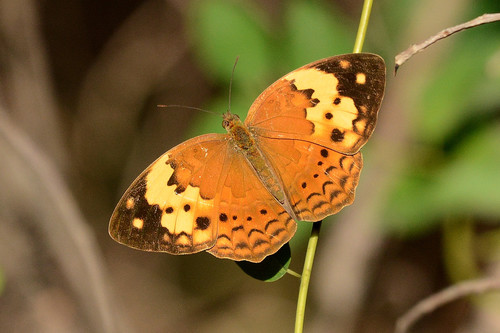
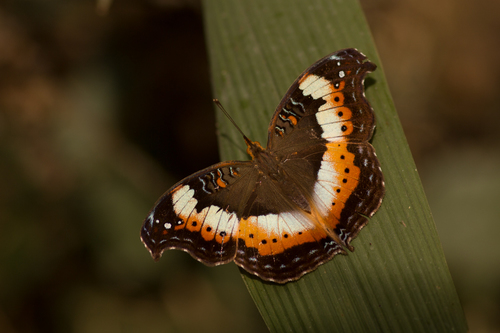
Precis pelarga (originally described by Fabricius in 1775) has a wingspan of roughly 43 to 51 millimetres, equal to 1.7 to 2.0 inches. Its forewings have a falcate, or hooked, shape. A distinct band crosses both the forewings and hindwings; this band shows seasonal polymorphism, appearing orange-white in the wet season and bluish white in the dry season. The basal area of the wings is brown, while the wing margins are blackish and marked with a row of small white spots. The undersides of the wings are variegated, with yellowish-brown cryptic colouration that mimics dead leaves. The larvae of Precis pelarga feed on Solenostemon and Coleus, which are both plant species in the Lamiaceae family. This species is found in tropical Africa, with confirmed presence in Senegal, Angola, Zambia, the Democratic Republic of the Congo, Uganda, western Kenya, Ethiopia, and Eritrea. It inhabits open forests and savannah, at elevations ranging from 0 to around 1,350 metres, or 0 to 4,429 feet, above sea level.