About Precis octavia (Cramer, 1779)
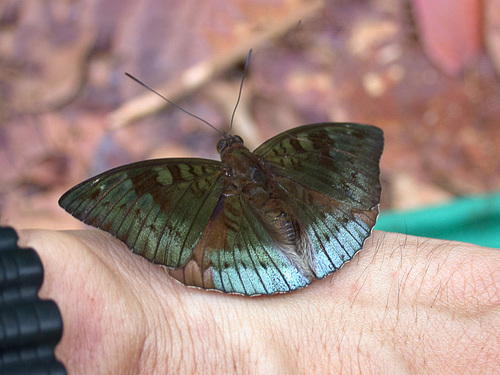
Precis octavia, commonly called the gaudy commodore, was first described by Pieter Cramer in 1779. This butterfly species has two recognized subspecies, both displaying strong seasonal dimorphism, with different wing forms appearing in different seasons. The nominate subspecies Precis octavia octavia has a wet season form that is orange with a pinkish flush and black markings on the upperside, and a dry season form that is shining blue with a vivid red band on the hindwing. This subspecies is distributed from eastern Senegal, Guinea, Burkina Faso, Sierra Leone, Liberia, Ghana, Togo, Benin, and Nigeria, west through Cameroon, Gabon, the Republic of the Congo, northern and central Democratic Republic of the Congo, the Central African Republic, and north to South Sudan, Ethiopia, Somalia, and Zimbabwe. The southern subspecies Precis octavia sesamus occurs from the border region of the Eastern and Western Cape in South Africa, along the eastern side of South Africa, north to Eswatini, Mozambique, Tanzania, and Kenya. This southern subspecies also has two seasonal forms: the summer form natalensis, which is red with black markings, and the winter form sesamus, which is blue with a line of red markings on the wings. The winter form of P. o. sesamus is slightly larger than the summer form. For both seasonal forms of P. o. sesamus, males and females have similar appearance, but females are slightly larger. In his authoritative two-volume book Butterflies of West Africa, Torben B. Larsen writes, "I believe this species has the most spectacular seasonal dimorphism of any butterfly, and the two morphs were [first] described as distinct species." Intermediate forms between the two seasonal morphs are rare in wild nature, but they can be easily produced in captive breeding conditions, showing a wide range of mixtures of the wing patterns of the two seasonal forms.