About Prasophyllum suttonii R.S.Rogers & B.Rees
Taxon Identity and Basic Growth Form
According to the National Herbarium of New South Wales, Prasophyllum suttonii (mauve leek orchid) is a terrestrial, perennial, deciduous herb with an underground tuber.
Leaf Morphology
It produces a single tube-shaped leaf that can grow up to 200 mm (8 in) long.
Inflorescence and Flower Arrangement
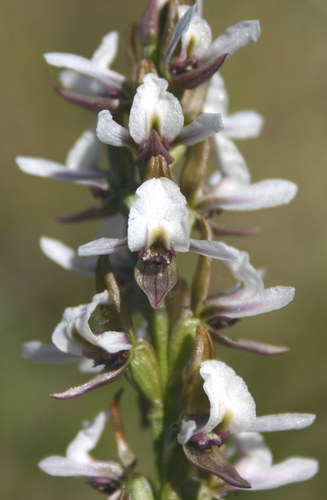
Up to thirty-five fragrant, crystalline white flowers marked with purple or mauve are crowded along a flowering stem that reaches 400 mm (20 in) in height.
Flower Orientation
Like other species in the Prasophyllum genus, this orchid has inverted flowers, meaning the labellum sits above the column rather than below it.
Dorsal Sepal Morphology
The dorsal sepal is egg-shaped to lance-shaped and up to 9 mm (0.4 in) long.
Lateral Sepal Morphology
Lateral sepals are up to 7 mm (0.3 in) long, usually free from one another, and sometimes joined by a thin membrane.
Petal Morphology
The petals are spatula-shaped, reaching up to 8 mm (0.3 in) long.
Labellum General Dimensions
The labellum is broad lance-shaped to egg-shaped, about 8 mm (0.3 in) long and 4 mm (0.2 in) wide.
Labellum Structure and Margins
It turns sharply upwards near its middle, extending above the lateral sepals, and its upturned edges are crinkled or folded.
Labellum Callus Feature
A green, channelled callus runs along the center of the labellum.
Flowering Period and Taxonomic Variation Notes
Flowering occurs from January to March, though the Royal Botanic Gardens Victoria and David Jones note this species produces fewer flowers per stem, has smaller flower organs overall, and flowers in December.
Habitat and Distribution
This orchid grows in wet bogs within alpine and subalpine heath and grassland, and occurs mainly in Kosciuszko National Park in New South Wales.
Victorian Conservation Listing
Victorian authorities list the species as endemic to Victoria and classify it as Presumed Extinct, as it has not been collected in the state since 1902.
Taxonomic Identification Controversy
However, Rudie Kuiter argues the species is not extinct on Mt Buffalo or elsewhere in Victoria, and that records of P. suttonii in the area have instead been re-identified as Prasophyllum alpestre.