About Prasophyllum flavum R.Br.
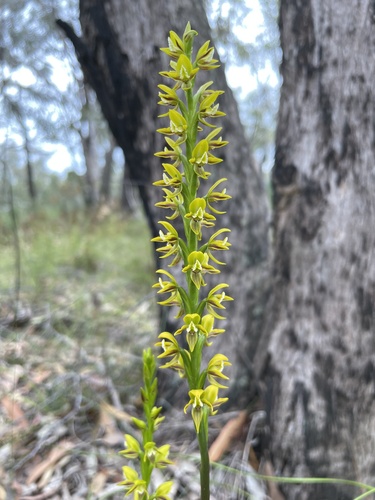
Prasophyllum flavum R.Br. is a terrestrial, perennial, deciduous herb that grows from a rhizome-like underground tuber. It produces a single tube-shaped leaf that reaches up to 60 mm (2 in) long, with a free section that measures less than 30 mm (1 in) long. Between 8 and 50 fragrant flowers, each up to 10 mm (0.4 in) across, grow crowded along a flowering spike that can reach up to 900 mm (40 in) tall. The flowers are yellowish-green, with the ovary pressed against the flowering stem. Like other species in the genus Prasophyllum, the flowers of this species are inverted, so the labellum sits above the column instead of below it. The dorsal sepal is egg-shaped to lance-shaped, up to 10 mm (0.4 in) long, and is deeply concave, or dished. The lateral sepals are also up to 10 mm (0.4 in) long, dished like the dorsal sepal, and are usually, but not always, joined for most of their length. The petals are egg-shaped to lance-shaped, up to 8 mm (0.3 in) long, and end in a pointed tip. The labellum is egg-shaped to lance-shaped, up to 8 mm (0.3 in) long, curves upwards, and has wavy, wrinkled edges. Flowering occurs between October and January. Commonly known as the yellow leek orchid, this species grows in moist, fertile soils within high-rainfall forests. It is found on the coast and ranges of New South Wales, in Victoria, south-east Queensland, and Tasmania.