About Potentilla erecta (L.) Raeusch.
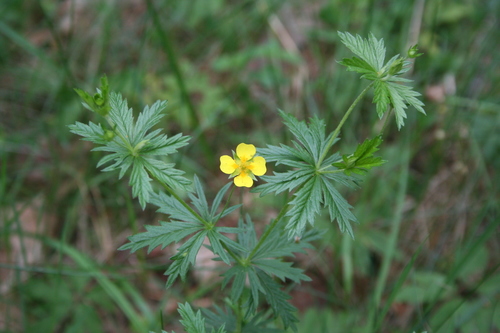
Potentilla erecta (L.) Raeusch. is a low, clump-forming plant that grows 10–30 centimetres (3.9–11.8 in) tall. It has slender stalks that range from procumbent to arcuately upright, and non-rooting runners. Wild populations grow predominantly in Europe and western Asia, mostly on acid soils across a wide range of habitats including mountains, heaths, meadows, sandy soils, and dunes. This species flowers from May to either August or September. A single yellow flower, 7–11 millimetres (0.28–0.43 in) wide, grows at the tip of a long stalk. It almost always has four notched petals, each 3 to 6 mm long; four-petaled flowers are rather uncommon in the rose family. The petals are somewhat longer than the sepals, and the flower has 20–25 stamens. Radical leaves have a long petiole, while leaves borne on flowering stalks are usually sessile or have short petioles. The glossy leaves are alternate and ternate, formed of three obovate leaflets with serrated margins. The paired stipules are leaflike and palmately lobed. The plant produces 2–8 dry, inedible fruits. Its rhizomatous root is thick. It has little value as food due to its bitterness and low caloric content. The roots are the main ingredient of Blutwurz, a bitter liqueur from Bavaria and the Black Forest area. It is also used in Ukraine alongside honey to make horilka. Due to its unusually high tannin content for a herbaceous plant, Potentilla erecta is used as an astringent in herbal medicine. Structurally related phlobaphenes, which form the red leather dye called tormentil red, can be extracted from the root of common tormentil along with the triterpene alcohol tormentiol. Aqueous extracts of the rhizomes are reported to have low toxicity in rats and mice.