About Potamogeton robbinsii Oakes
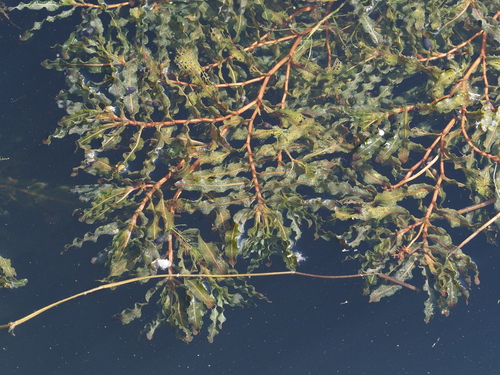
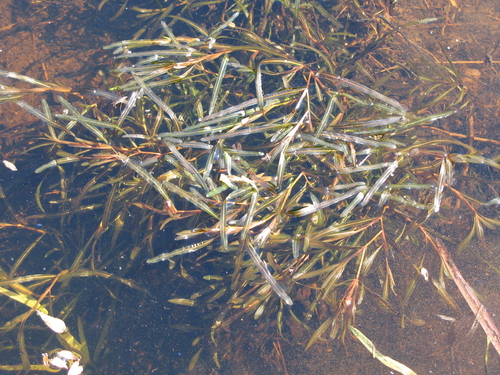
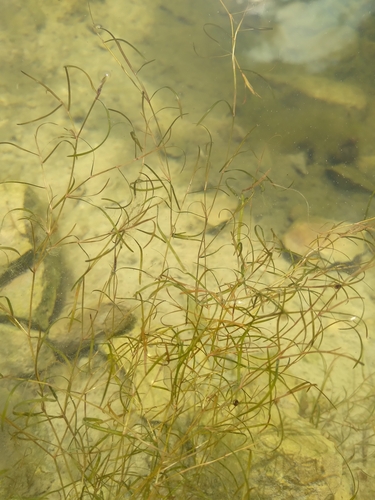
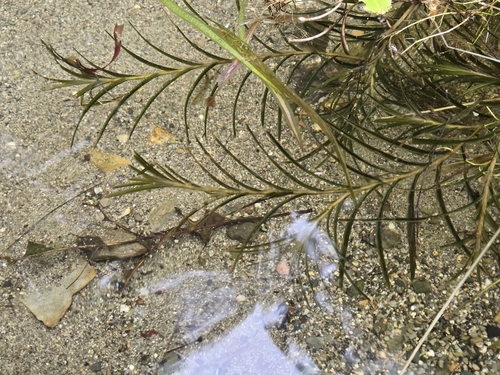
Potamogeton robbinsii Oakes has a rootstock with no tubers. Its stems grow roots from their lower nodes; sterile stems are either simple or widely branching, have a feather-like form, and are covered with whitish sheathing stipules. Sterile stems reach 10–90 cm (3.9–35.4 in) in length, while flowering stems can grow up to 2 m (6 ft 7 in) tall. Leaves on sterile stems are linear, stiff, and grow oppositely along the stem, measuring 3–8 mm (0.12–0.31 in) long. These leaves are densely crowded on sterile stems, have auricles at their base, and bear minutely serrated margins. The tip of the fibrous, pale stipule on sterile stems is equal in length or longer than the stipule's sheath. By contrast, leaves that grow on flowering stems are spaced apart and reduced in size, and their stipules have shorter tips. The branching inflorescence holds one to twenty-six straight peduncles that carry stiff, interrupted spikes 0.7–2 cm (0.28–0.79 in) long. This species fruits rarely. When it does produce fruit, the fruit is flattened, measuring 4–5 mm (0.16–0.20 in) long and 2.7–3.3 mm (0.11–0.13 in) wide. The fruit has a prominent keel and an approximately central beak that is 1 mm (0.039 in) long. Flowering occurs from August to September. Potamogeton robbinsii may form dense colonies that form a carpet over muddy substrates on river bottoms and lake beds. It rarely produces flowers, but when it does flower, it is very easy to identify, because it is the only Potamogeton species that has branching inflorescences.