About Potamogeton pusillus L.
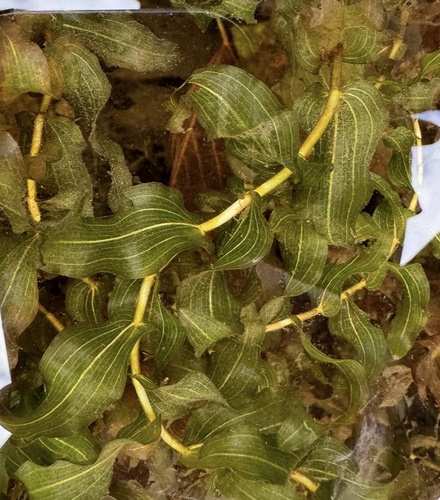
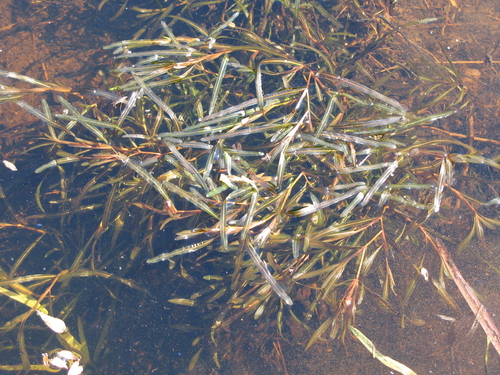
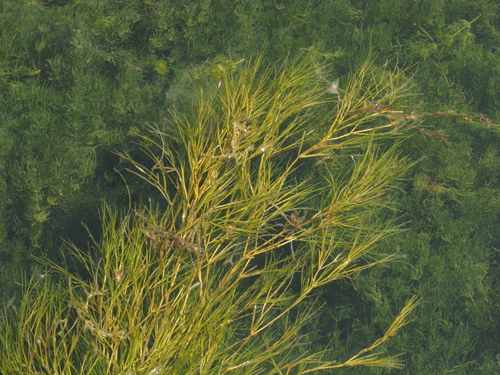
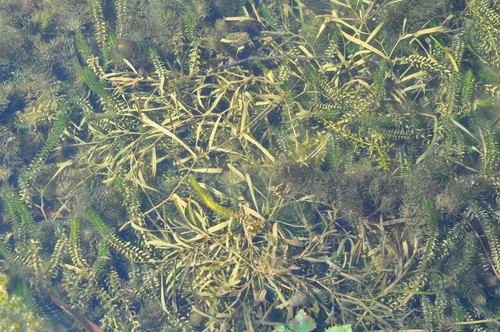
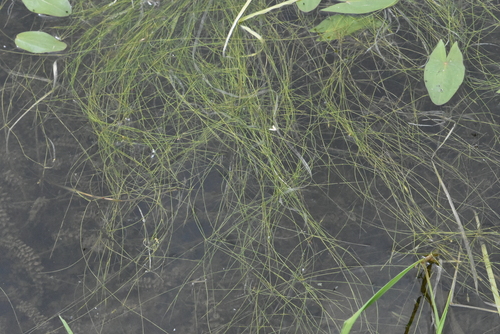
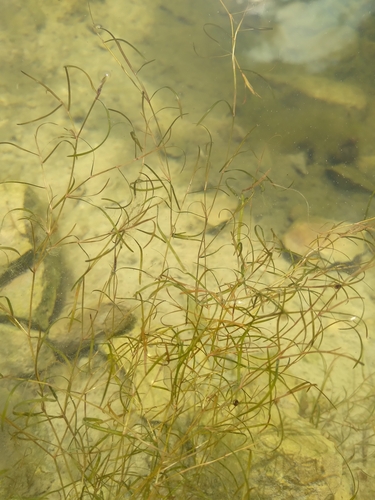
Potamogeton pusillus L., commonly known as lesser pondweed, is a superficially grass-like aquatic herb. It produces a very slender, branching, somewhat compressed stem, usually less than 70 cm long, though it can occasionally reach one metre in length. Nodal glands, when present, are generally poorly developed. Its leaves are narrow and linear, translucent, and coloured mid or olive green. They typically measure 20–50 mm long by 0.8–1.4 mm wide, rarely growing up to 100 mm long and 1.9 mm wide. The midrib usually has no lacunae (transparent areas on either side of the midrib); if lacunae are present, they are restricted to the lower half of the leaf. This species does not produce floating leaves. Its stipules are tubular when young, but tend to split as they age. Lesser pondweed produces turions, often in large quantities. In early autumn, the entire plant disintegrates into a mass of turions, which function as a means of propagation and an overwintering mechanism. Its inflorescence is a spike holding 3–6 flowers arranged in interrupted whorls. Like most fine-leaved pondweeds, Potamogeton pusillus is diploid, with a chromosome count of 2n=26. It can be difficult to reliably distinguish lesser pondweed from other fine-leaved pondweeds, especially Potamogeton berchtoldii. Recorded hybrids exist between Potamogeton pusillus and Potamogeton octandrus (named P. × apertus Miki), P. polygonus (P. × attenuatus Hagstr.), P. obtusifolius (P. × saxonicus Hagstr.), P. trichoides (P. × grovesii Dandy & G.Taylor), P. berchtoldii (P. × mucronulatus (G.Fisch.) Papch.), and P. oxyphyllus (P. × orientalis Hagstr.). Lesser pondweed has a wide global distribution. It occurs across most of Europe, including Scandinavia, and throughout North America. It has been reported from scattered locations in Central and Southeast Asia, is widespread across China, and is also widespread in both South America and Africa. Lesser pondweed grows in standing or slow-flowing water bodies including ponds, lakes, ditches, slow-moving streams, and river backwaters. It is a lowland plant that requires calcareous water, and shows a marked preference for high nutrient levels. In favourable conditions, it may form extensive beds, growing alongside other nutrient-tolerant species such as Myriophyllum spicatum and Zannichellia palustris. It is tolerant of turbid water and an effective colonist, often growing in temporary or disturbed habitats such as livestock drinking ponds, canals and ditches. In lakes, it is very tolerant of eutrophication and the resulting competition from phytoplankton and periphyton, and is often one of the last submerged plants to disappear. Globally, Potamogeton pusillus is listed as Least Concern. There is no evidence of local population declines, and in many areas it is likely increasing due to eutrophication of freshwater habitats. Across much of its range, it is the most common fine-leaved pondweed. Lesser pondweed should not be difficult to grow in a garden pond, and its tolerance of poor water quality is an advantage. However, it is not considered very ornamental.