About Potamogeton praelongus Wulfen
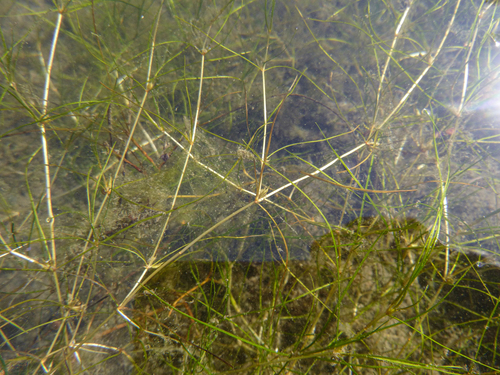
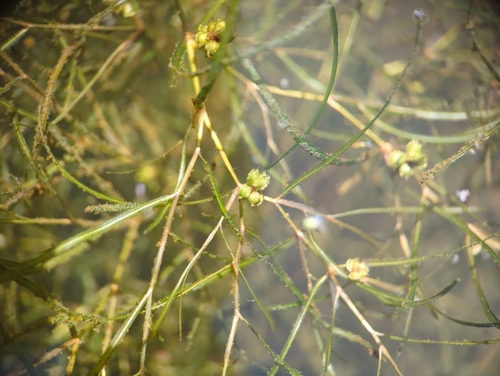
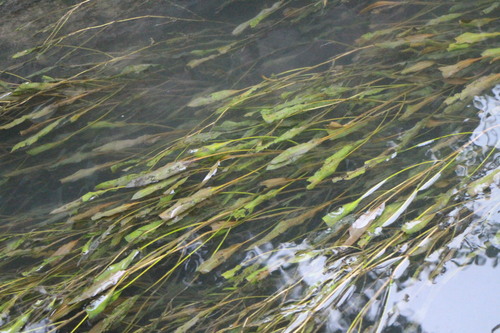
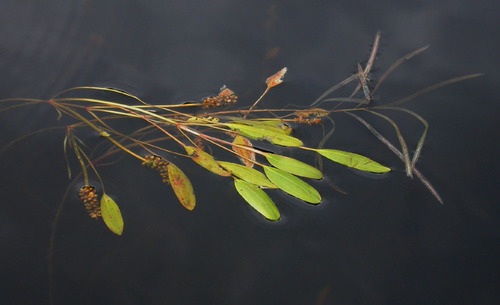
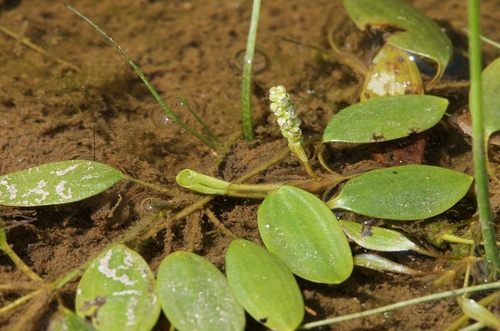
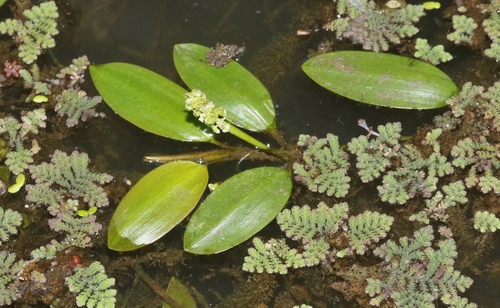
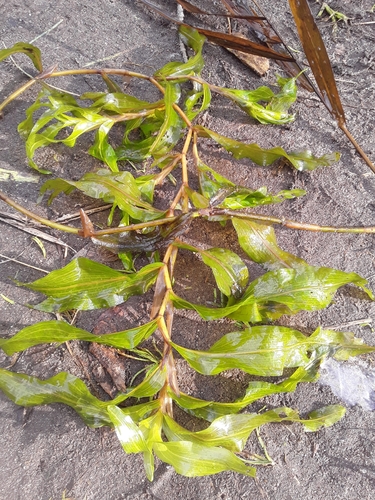
Commonly called long-stalked pondweed, Potamogeton praelongus Wulfen grows from sturdy, rusty-spotted perennial rhizomes and produces tall stems up to 3 m long. Stems typically change direction between each node, forming a characteristic zig-zagging pattern. Its transparent leaves, which range from pale to deep green, are usually 60–150 mm long (occasionally reaching 250 mm) and 14–40 mm wide. The stipules are persistent, open, whitish, and translucent, and develop prominent veins when dry. This species does not produce floating leaves or turions. It develops inflorescences earlier in the year than many other pondweeds, from May to June. These inflorescences hold 15–20 inconspicuous greenish flowers, and are borne on thick peduncles 80–200 mm long. Its fruits are large for a pondweed, measuring 4.5–5.5 × 2.5–3.6 mm. Hybrids between Potamogeton praelongus and several other Potamogeton species have been documented: P. alpinus (P. × griffithii A. Benn.), P. crispus (P. × undulatus Wolgf.), P. lucens (P. × jutlandicus Zalewska-Gał.), P. natans (P. × vepsicus A.A. Bobrov & Chemeris), and P. perfoliatus (P. × cognatus Asch. & Graebn.), though all these hybrids are rare. Like most other broad-leaved pondweeds, P. praelongus is tetraploid, with a confirmed chromosome count of 2n=52. This species is relatively easy to identify. While it may be mistaken for narrow-leaved forms of Potamogeton perfoliatus, it can be distinguished by its persistent stipules, leaves that only partially clasp the stem, larger fruits, and the usual zigzag stem pattern. Hybrids are often harder to identify, but typically display various characteristics from the other parent species. Potamogeton praelongus has a Holarctic distribution. It grows in northern Europe (including Britain, Ireland, Iceland, Scandinavia, Germany, Switzerland, France, Poland, Russia, and the Baltic States), Greenland, Asia (including Siberia, China, Korea, and Japan), and North America (including the northern United States and Canada). Outlying populations also exist in the Caucasus, Pyrenees, and western USA. Potamogeton praelongus is not generally cultivated, though it is considered an attractive plant. Unlike many other pondweeds, it stays green through the winter. Like other related pondweeds, it roots poorly from stem cuttings, so it is best propagated by dividing its rhizomes. Its preference for relatively deep water and intolerance of turbid conditions can make it unsuitable for many garden ponds. When grown, it should be placed in water at least 70 cm deep, in a sandy, peaty, or silty substrate. Good water quality is required to lower the risk of turbid water or blanket weed growth. To encourage germination, dried seed can be immersed in water for at least a month, exposed to a cold period, or scarified.