About Potamogeton gramineus L.
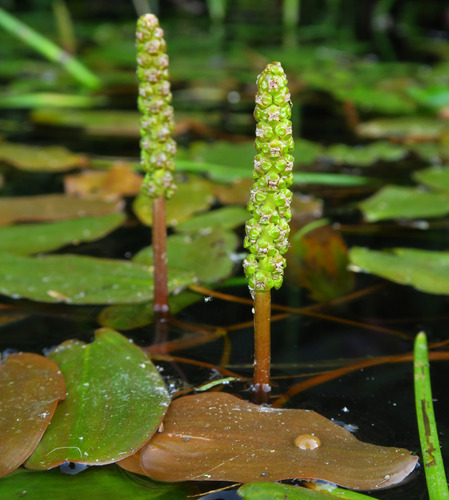
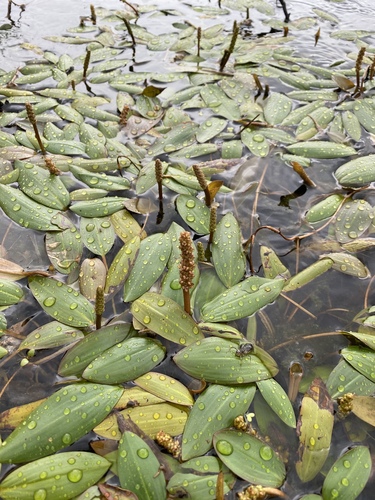
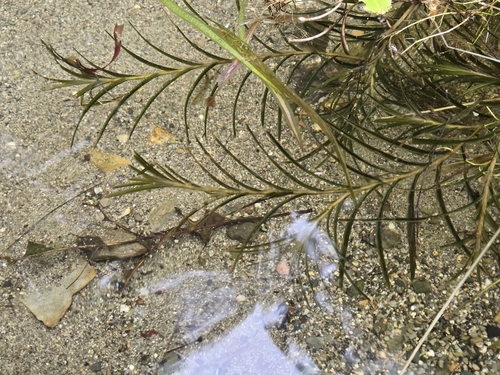
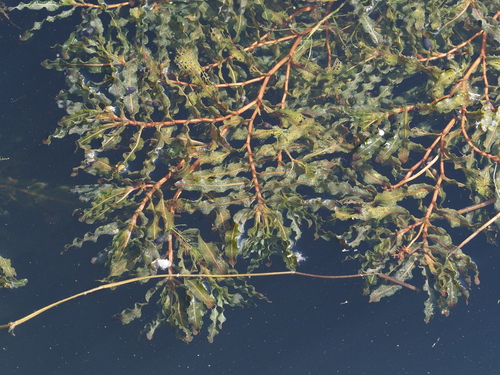
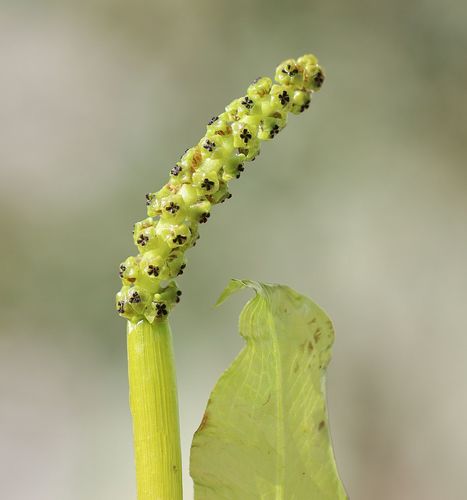
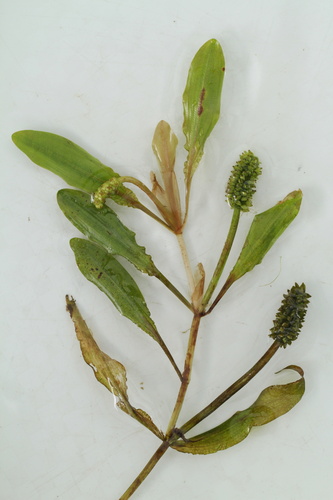
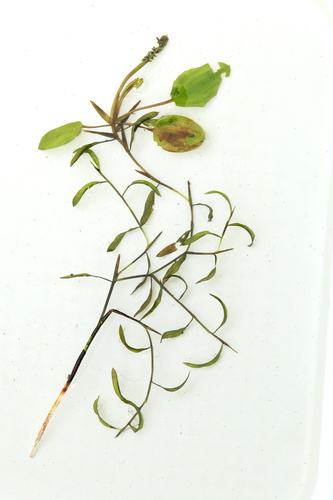
Potamogeton gramineus L., commonly called various-leaved pondweed, is an aquatic perennial plant that grows from a creeping rhizome which anchors it in wet substrate. It produces thin, cylindrical, heavily branched stems that are usually less than one metre long. Its submerged leaves are stalkless (sessile) and relatively narrow; on main stems they are typically 40–90 mm long and 5–12 mm wide, while leaves on side branches are smaller. These submerged leaves are translucent pale green with a white midrib, and have finely toothed edges. Its floating leaves have a more oval shape, measuring 20–70 mm long by 7–34 mm wide, and grow on long petioles. The inflorescence is a short spike of many flowers that rises above the water on a thick peduncle.
This species readily hybridizes with many other Potamogeton species. Confirmed recorded hybrids include P. × nitens Weber (cross with P. perfoliatus), P. × angustifolius J.Presl. (cross with P. lucens), P. × sparganiifolius Laest. ex Fr. (cross with P. natans), P. × billupsii Fryer (cross with P. coloratus), P. × biwaensis Miki (cross with P. maackianus), P. × spathuliformis (J.W.Robbins) Morong (cross with P. illinoensis), P. × hagstromii A.Benn. (cross with P. richardsonii), P. × nericius Hagstr. (cross with P. alpinus), P. × lanceolatifolius (Tiselius) C.D.Preston (cross with P. nodosus), P. × mirabilis Z.Kaplan, Hellq. & Fehrer (cross with P. oakesianus), and the cross with P. polygonifolius. A triple hybrid, P. gramineus × lucens × perfoliatus (P. × torssandrii (Tiselius) Dörfler), is also documented. In Britain, P. × nitens and P. × angustifolius are quite common. Recent molecular analysis has shown that Swedish collections previously thought to be the hybrid P. gramineus × P. polygonifolius are actually P. gramineus × P. nodosus. In addition to frequent hybridization, various-leaved pondweed is an extremely variable species, so care must be taken when identifying it.
Potamogeton gramineus is native to much of the Northern Hemisphere, with a Holarctic distribution. It is found across northern Europe (including Britain, Ireland, Iceland, Scandinavia, Germany, Switzerland, France, Poland, Russia, and the Baltic States), Greenland, and most of North America, where it occurs across Canada and the United States except the southeastern US. Outlying populations exist in southern Europe (Iberia, Corsica, Italy), the Caucasus, the Pyrenees, and parts of western US.
Various-leaved pondweed grows in a range of water body types, including ponds, lakes, bogs, ditches, and streams. It is usually restricted to shallower water less than 1 metre deep, though it has been recorded growing at more than 5 metres depth in the very clear, oligotrophic water of Llynnau Cregennen, Wales. It cannot tolerate nutrient pollution, and it is not typically found in base-poor water with an alkalinity of less than approximately 200 μEq/L. Its roots penetrate to a depth of about 10 centimetres. In Michigan streams, P. gramineus is restricted to riffles with warmer interstitial water temperatures.
Waterfowl grazing can have a significant impact on populations of various-leaved pondweed. At Sentiz Lake in Leon, Spain, P. gramineus grew sparsely, with Ceratophyllum demersum and Myriophyllum spicatum as the dominant plants. However, within experimental cages that excluded waterfowl, P. gramineus became co-dominant and produced both flowers and floating leaves.
In Britain, this species has shown the same pattern of decline seen in other broad-leaved pondweeds such as P. praelongus and P. alpinus, with most losses occurring in southern Britain. It is currently classed as Near Threatened in England. This decline is likely linked to increasing eutrophication, river canalization that eliminates backwater and other floodplain standing water habitats, and general degradation or loss of pond and lake habitats. P. gramineus may also grow in open reedbeds, and loss of traditional reed cutting practices may have eliminated populations from this habitat. Across Europe, its conservation status varies: it is Critically Endangered in the Czech Republic, Endangered in Germany, Flanders, and Switzerland, Near Threatened in the Netherlands, and considered scarce and of high conservation importance in Spain. Local extinction was recorded in Lower Saxony between 1948 and 1986. In the United States, it is listed as Threatened in Illinois, and Endangered in Ohio and Pennsylvania.
European environmental tolerance indices based on trophic ranking consistently show P. gramineus to be one of the most nutrient-sensitive aquatic plants. Studies in the Netherlands have found P. gramineus is associated with Littorelletea lakes, and is one of a group of species sensitive to acidification. Various-leaved pondweed belongs to the Magnopotamion group of pondweeds, which are a characteristic floristic component of the protected European Habitats Directive habitat Type 'Natural eutrophic lakes with Magnopotamion'. However, in Britain P. gramineus also occurs in lower-nutrient waters, and is considered a characteristic species of mesotrophic lakes.
Potamogeton gramineus is not generally grown in cultivation, though it is an attractive plant that grows well in garden ponds or tubs. It grows slower than most other submerged aquatic species, has attractive foliage, and produces only a limited number of floating leaves, making it very ornamental and well-suited for garden ponds. Its smaller size compared to many other pondweeds is also an advantage. Like other pondweeds in this group, it roots poorly from stem cuttings, so it is best propagated by dividing its rhizomes.