About Posidonia oceanica (L.) Delile
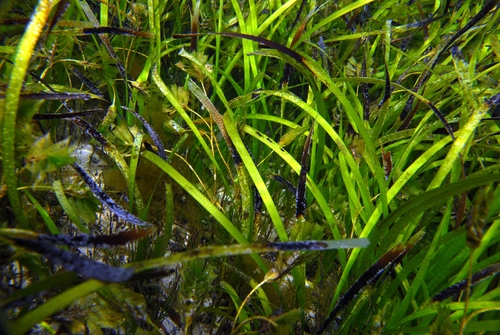
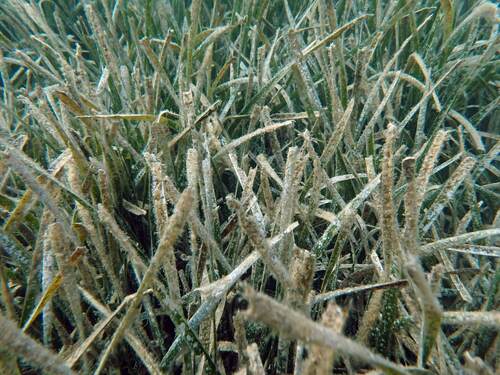
Posidonia oceanica (L.) Delile, commonly known as Neptune grass, is a species of flowering sea grass. This species is found exclusively in the Mediterranean Sea, where it is currently in decline, occupying approximately 3% of the basin (around 38,000 km² of surface area). Posidonia oceanica has roots that mainly function to anchor the plant to the substrate, along with rhizomes and tapeform leaves. Rhizomes reach up to 1 cm thick, and grow in two forms: horizontally growing plagiotropic rhizomes, and vertically growing orthotropic rhizomes. Horizontal rhizomes anchor the plant to the substrate via lignited roots up to 15 cm long at their base. Vertical rhizomes increase the plant’s height and help counteract sand coverage from continuous sedimentation. These two growth patterns create a terrace-shaped mat formation made of a network of rhizome strata, roots and trapped sediments. This growth allows Neptune grass to colonize environments that algae cannot easily occupy, as algae lack true roots. Leaves grow from orthotropic rhizomes; they are ribbon-shaped, bright green when young that turns brown as they age. They can reach up to around 1.5 m in length, with an average width of 1 cm, and feature 13 to 17 parallel veins. Leaf apexes are rounded, and are often worn away by the action of waves and currents. Leaves grow in groups of six or seven per bush, with the oldest leaves positioned on the outside and the youngest on the inside. There are three categories of leaves: adult leaves have a photosynthetic lamina and a base separated from the leaf edge by a concave structure called a ligula; intermediate leaves have no base; young leaves are normally less than 50 mm long. In autumn, the plant sheds its outermost adult leaves, which turn brown and stop photosynthesizing; new leaves are produced during winter. Some sources note leaves reaching only 45 cm long. The rhizomatous stems have a dual growth habit, with one growing around 150 cm below the substrate and the other growing above it; all stems are approximately 10 mm thick. The resulting mat has active plant tissue at its surface, while the center consists of a dense network of roots and decomposing stems. In the Mediterranean, it grows in dense meadows or along sandy channels at depths between 1 and 35 metres, with depth depending on water clarity. Subsurface rhizomes and roots stabilize the plant, while erect rhizomes and leaves reduce silt accumulation. It grows best in clean water, so its presence is an indicator of low pollution. Decomposing leaf masses washed up on beaches can be used to detect the presence of Posidonia meadows offshore. A UNESCO World Heritage Site around the Balearic Islands of Mallorca and Formentera includes around 55,000 hectares of P. oceanica. This population has global significance because of the large amount of carbon dioxide it absorbs, relevant to climate change effects. Today, its meadows are threatened by rising temperatures that slow growth, plus damage from boat anchors. In 2006, a huge clonal colony of P. oceanica was discovered south of Ibiza, stretching south to La Savina and Es Pujols on Formentera. This colony is 8 km across and estimated to be 100,000 years old, making it one of the largest and oldest clonal colonies on Earth. Dead rhizomes mixed with olive-mill waste are used for compost, though Italian laws prohibit the use of marine algae and marine plants including this species for composting. Posidonia oceanica reproduces both sexually and asexually, with asexual reproduction occurring via stolons. Sexual reproduction happens through the production of flowers and fruits. The flowers are hermaphroditic, grouped into herringbone-shaped green inflorescences enclosed between floral bracts. A peduncle connects the inflorescence to the rhizome at the center of the leaf bush. The gynoecium is made of a unilocular ovary that connects to a style and ends in a stigma. The androecium consists of three stamens with short anthers. Flowering depends on environmental factors (light and temperature) and endogenous factors (plant age and size). It occurs in September and October in meadows closest to the sea surface, and is delayed by two months in deeper meadows. Pollen is spherical inside anthers, and becomes filamentous immediately after release into water. There are no pollen-stigma recognition mechanisms to prevent self-fertilization. Pollination is water-based, and can lead to fruit formation, though some fruits do not reach full maturation, which takes six months. Once ripe, fruits detach and float on the water surface. The slightly fleshy fruit, sometimes called "sea olive", is similar to a drupe, with a porous pericarp rich in oily material that enables flotation. When the fruit rots, it releases a seed that is covered by a thin membrane with no true proper outer tegument. The seed falls to the seabed, and if depth, stability and sediment conditions are suitable, it germinates to grow a new plant. For establishment, the seed must find a suitable substrate with sufficient organic matter from degraded plant remains, so new plants can become established on substrates previously colonized by other species such as macroalgae or other phanerogams. This forms an ecological succession where Posidonia oceanica represents the final climax stage. Germination begins when the seed produces a small white root from the radical pole and a leaf from the apical pole. Sexual reproduction allows the species to colonize new areas, spread meadows to new locations, and maintain genetic variability. Asexual reproduction via stolons uses plagiotropic rhizomes, which grow around 7 cm per year to colonize new space, allowing existing meadows to expand. High sediment accumulation and reduced space for horizontal growth stimulate vertical rhizome growth, which forms the characteristic leaf bushes.