About Posidonia australis Hook.f.
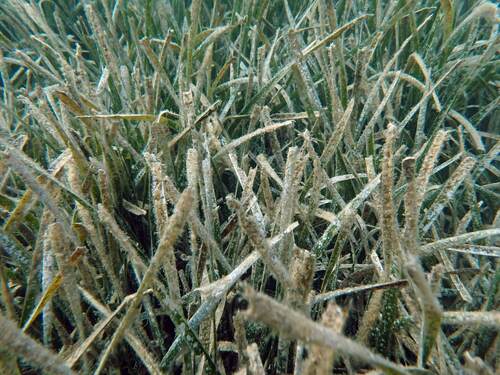
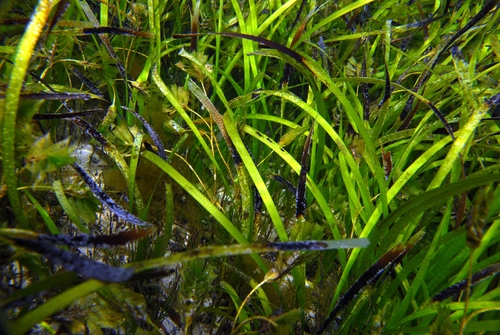
Posidonia australis Hook.f. is a flowering seagrass that grows in dense meadows or along channels in white sand. It occurs at depths ranging from 1 to 15 meters (3 to 49 feet). Subsurface rhizomes and roots anchor the plant and give it stability in the sand it occupies, while erect rhizomes and leaves reduce silt accumulation. The leaves of this species are ribbon-shaped, 11 to 20 millimeters (0.43 to 0.79 inches) wide, and bright green, often turning brown as they age. Leaf tips are naturally rounded, and may be missing due to damage. Leaves are grouped in clusters, with older leaves positioned on the outside of the cluster; these older leaves are longer and differ in form from the younger leaves they surround. Posidonia australis is a monoecious species. Its flowers grow on small spikes located on leafless stems, with two bracts on each spike. The plant pollinates via hydrophily, dispersing pollen through water. It typically reproduces through either sexual or asexual methods, but can reproduce via pseudovivipary under extreme conditions. A 2013 study found that P. australis can sequester carbon 35 times more efficiently than rainforests. In 2022, a study conducted by the School of Biological Sciences and Oceans Institute at The University of Western Australia documented that a single individual of this species can grow vegetatively using rhizomes to cover a very large area, in a growth pattern similar to buffalo grass. This specific specimen has double the chromosome count of other studied populations, holding 40 chromosomes instead of the usual 20. This species is found in coastal waters around the southern coast of Australia. In Western Australia, it occurs in the Shark Bay region, around the islands of the Houtman Abrolhos, and extends southward along the coast of the Swan Coastal Plain. It has also been recorded at the edge of Esperance Plains, in the Archipelago of the Recherche, on the southern coast of the region's southwest area. Its range extends east to coastal areas of New South Wales, South Australia, Tasmania, and Victoria. A common indicator of nearby Posidonia australis growth is the presence of masses of decomposing leaves washed up on beaches, which form fibrous balls.