About Porzana tabuensis (Gmelin, 1789)
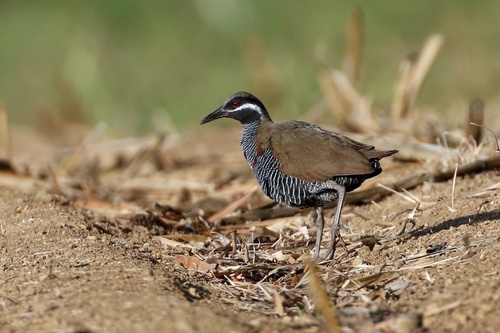
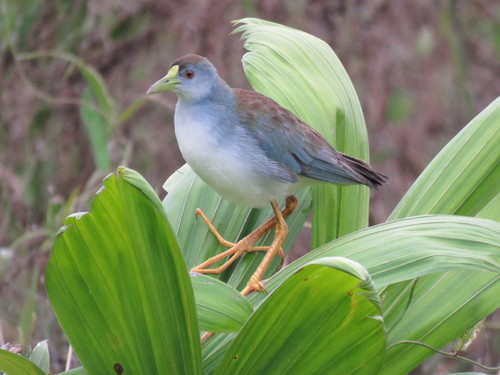
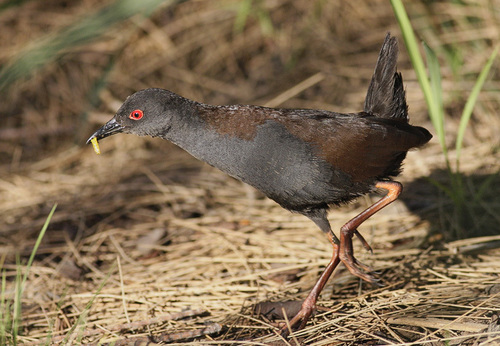
The spotless crake (scientific name Porzana tabuensis (Gmelin, 1789)) has the following description. Adult spotless crakes reach 17–20 cm in length, have a 26–29 cm wingspan, and weigh 40–50 g. Their head and neck are bluish-grey slate; some individuals have an occasional light grey or whitish patch on the chin that can extend down the throat. The back, outer wings, and inner wings are dark reddish-brown, which fades to dark blackish-brown on the tail feathers. The underside of the bird is also bluish-grey, transitioning to blackish-grey on the underside of the tail feathers. It has a black bill, deep red eyes that contrast sharply with the head, and reddish-pink legs and feet. Spotless crakes lack obvious sexual dimorphism, so it is difficult to tell males and females apart. Juveniles are similar to adults, but have duller colouring across their whole body, and are paler and browner than mature crakes. They have a white patch on the chin and throat, a dull brown back, and dull grey-brown colouring on the head and underside. Juvenile eyes are brownish-orange, and turn red as the bird matures. Juvenile leg and foot colour varies between olive-brown, brownish-grey, and brownish-flesh, and also turns red as the bird matures. The spotless crake produces a variety of calls, though little is known about the purpose of each call. Originally seven distinct calls were detected, including a bubbling sound, a sharp high-pitched 'pit-pit', a 'mook' call that varies in loudness and pitch, and a loud 'purring' call. The high-pitched purr sound is thought to be this species' song. It consists of a rapid series of roughly 25 notes per second, and is the species' loudest call. More calls were detected initially, but only four have been formally described to date. The spotless crake is widely distributed across the south Pacific, including the Philippines, Moluccas, New Guinea, Melanesia, Australia, Tasmania, Norfolk Island, Indonesia, and south-west Polynesia including New Zealand. In New Zealand, where the species is also called pūweto, it is distributed across the North and South Island mainlands. It occurs in low numbers in the South Island, with only a handful of isolated communities on the west coast, east coast, and Southland. Its distribution across the North Island is much wider, though it still occurs in few communities, with most sightings near the northern end of the North Island. Nationally important sites for the species in New Zealand include the Awarua-Waituna wetland complex in Southland, Great Barrier Island, Kermadec Islands, Lake Wairarapa, Poor Knights Islands, Tiritiri Matangi Island, and Whangamarino wetland in Waikato. In addition to the mainland, spotless crakes have been found on many offshore New Zealand islands, including the Kermadec Islands, Manawatāwhi / Three Kings Islands, Poor Knights Island, and the Chatham Islands. Holocene fossils of the spotless crake have been found on both the New Zealand mainland and the Chatham Islands. Because the spotless crake is rarely seen, it is difficult to estimate its population size, so current population numbers for New Zealand are unknown. The species' scarcity in the South Island is thought to be due to two factors: the more dominant marsh crake, a related rail with very similar habitat requirements, pushing the spotless crake out of suitable habitat; and the spotless crake's lower tolerance for the South Island's colder climate, as it is mainly found in warmer coastal localities. Spotless crakes are freshwater wetland birds. Their preferred habitat is wetland and swamp areas with dense vegetation, which they use to build their nests. They forage on open muddy areas near dense vegetation, but retreat back into the vegetation when disturbed. On some small offshore islands with few wetlands, they have been recorded living and foraging in dry forest. Although raupo is generally the preferred habitat for spotless crake, they have also been found in swamps dominated by flax (Phormium tenax), tussock sedge (Carex secta), and cabbage tree (Cordyline australis). When their current habitat is not ideal, spotless crakes can migrate locally, a behaviour seen in other subspecies of the species elsewhere. Spotless crakes are omnivorous. Their diet includes seeds, fruits, grass shoots, aquatic plant leaves, adult and larval insects, mollusks, crustaceans, spiders, carrion, worms, beetles, and other insects.