About Porzana porzana (Linnaeus, 1766)
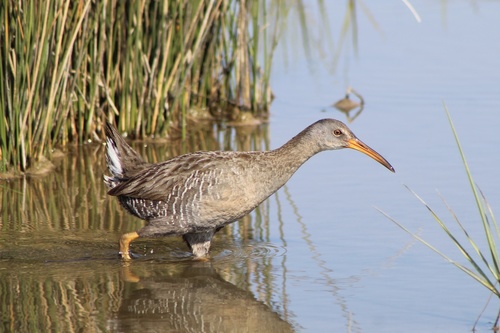
The spotted crake, scientifically named Porzana porzana, is a small waterbird belonging to the Rallidae family. Its scientific name originates from Venetian terms that refer to small rails. Spotted crakes breed in marshes and sedge beds that stretch from temperate Europe into western Asia. They build their nests in dry spots within marsh vegetation, and lay between 6 and 15 eggs per clutch. This species is migratory, and spends the winter in Africa and Pakistan. Adult spotted crakes measure 19 to 22.5 cm (7.5 to 8.9 inches) in length, making them slightly smaller than water rails. They can be easily told apart from water rails by their short, straight bill, which is yellow with a red base. Adults have mostly brown upperparts and a blue-grey breast, with dark barring and white spots on their flanks. They have green legs with long toes, and a short tail that is buff-colored on the underside. Immature spotted crakes have similar patterning to adults, but their brown plumage replaces the adult blue-grey breast color. Like all rail species, downy young spotted crake chicks are black. The sora, a rare vagrant from North America, is a species that is often confused with the spotted crake. However, soras lack breast spotting and have an unstreaked crown stripe, which distinguishes them from spotted crakes. Spotted crakes forage by probing their bill into mud or shallow water, and also pick up food by sight. Their diet consists mainly of insects and aquatic animals. During the breeding season, spotted crakes are very secretive, and are most often heard rather than seen. They are noisy birds in this season, with a distinctive, repetitive, whiplash-like call that sounds like hwuit, hwuit. They are typically easier to spot when they are migrating. The spotted crake is one of the species covered by the Agreement on the Conservation of African-Eurasian Migratory Waterbirds (AEWA). The Western European population of spotted crakes has declined in recent decades, and the species is now a very rare breeding bird in Great Britain.