About Porzana fusca (Linnaeus, 1766)
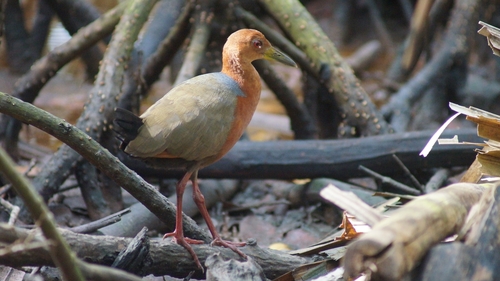
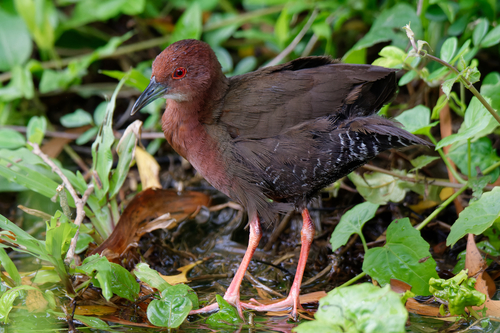
The ruddy-breasted crake, also called ruddy crake, is a waterbird belonging to the rail and crake family Rallidae. It was previously classified in the genus Porzana, and its scientific name is Porzana fusca (Linnaeus, 1766), with the synonym Zapornia fusca. Its breeding habitat consists of swamps and comparable wet areas across South Asia, ranging from the Indian subcontinent eastward to south China, Japan, and Indonesia. It has been documented as a vagrant on Christmas Island, an Australian territory. Most of the species is permanently resident across its entire range, though some northern populations migrate farther south for the winter. This crake builds its nest in a dry spot on the ground within marsh vegetation, and lays 6 to 9 eggs per clutch. The ruddy-breasted crake measures approximately 22 to 23 centimeters in total length. Its body is flattened laterally, which lets it move more easily through reeds and undergrowth. It has long toes and a short tail. Its back is pale brown, while its head and underparts are chestnut, with white barring on the flanks and undertail. The bill is yellowish, and the eyes, legs, and feet are red. Males and females have similar appearance, but juvenile birds are dark brown with some white spotting. These birds forage by probing in mud or shallow water, and also pick up food by sight. They eat shoots, berries, insects, and large snails; to eat large snails, they use their bills to peck through the hard shell. Ruddy-breasted crakes are territorial, and quite secretive, hiding in grassy shrubs and bushes when disturbed.