About Portia schultzi Karsch, 1878
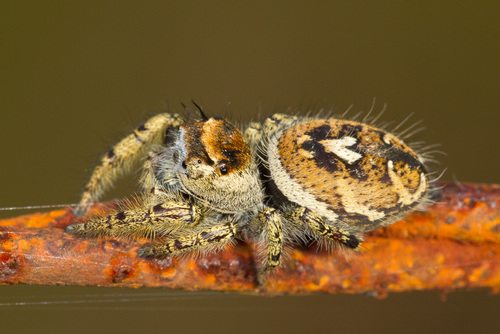
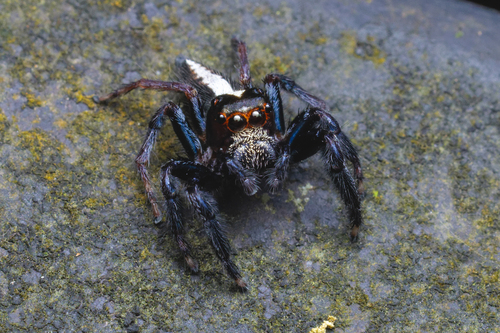
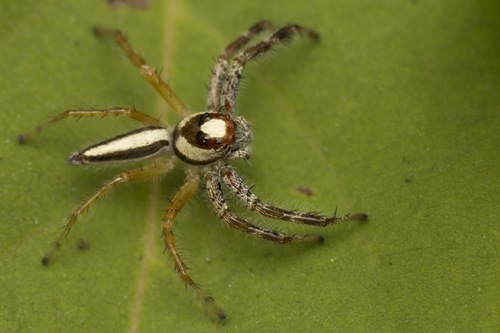
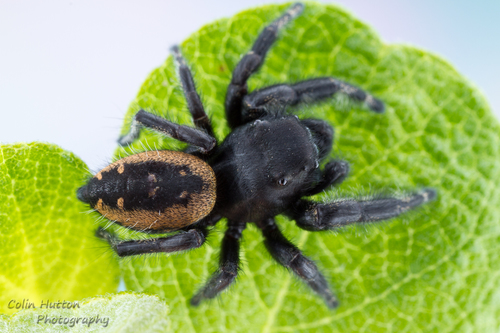
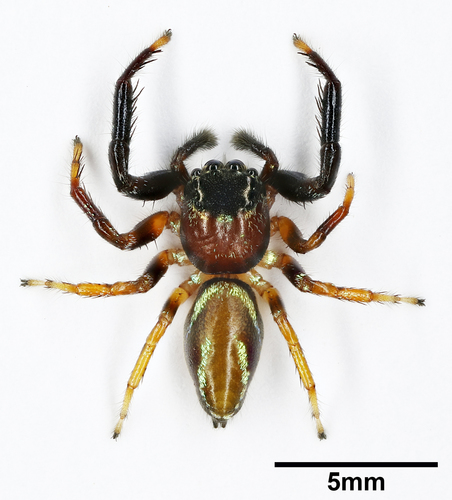
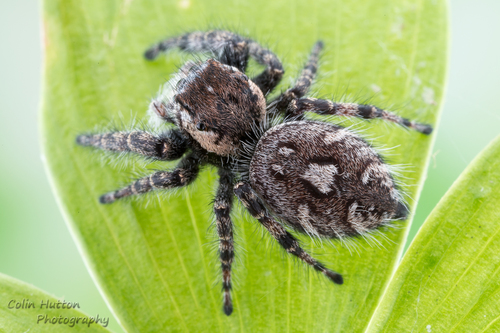
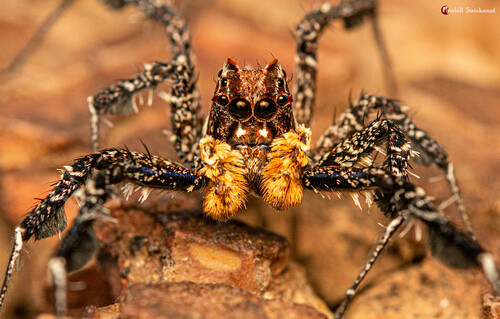
Portia schultzi Karsch, 1878 is a species of jumping spider. Its distribution ranges from South Africa in the south to Kenya in the north, and it is also found in West Africa and Madagascar; more specifically, its range extends from Durban, South Africa in the south to Malindi, Kenya in the north, westwards to the East African Rift, plus West Africa and Madagascar. This species is slightly smaller than some other species in the genus Portia. Female bodies are 5 to 7 mm (0.20 to 0.28 in) long, while male bodies are 4 to 6 mm (0.16 to 0.24 in) long. Both sexes have orange-brown carapaces with dark brown mottling, covered with lying dark brown and whitish hairs. Males have white tufts on their thoraces and a broad white band above the leg bases; these features are less conspicuous in females. Both sexes have orange to dark orange tufts above the eyes, which are fringed with pale orange hairs. Males have yellow-orange to orange-brown abdomens with blackish mottling, black and light orange hairs on the upper sides, and nine white tufts. Females have pale yellow abdomens with black markings, and scattered white and orange-brown hairs on the upper side. P. schultzi has relatively longer legs than other Portia, and uses a "lolloping" gait. While most jumping spiders can focus accurately on targets up to around 75 cm (30 in) away, P. schultzi only responds to targets up to about 10 cm (3.9 in) away in good light, and ignores all targets in very subdued light. When hunting, P. schultzi prefers web-based spiders as prey, followed by jumping spiders, and finally insects. Like other Portia species, female P. schultzi build "capture webs" to catch prey, and often attach their own webs to the webs of web-based spiders to catch the resident spiders or their prey. Mature female P. schultzi emit olfactory signals while hunting that reduce the chance that other P. schultzi of any age or sex will compete for the same prey. This species is often found in the dense, large webs of the 15-millimeter-long diplurid Ischnothele karschi. These I. karschi webs are especially abundant in partly cleared secondary bush where rainforests have been cut down, usually around one meter above the ground. A survey of one area found approximately one P. schultzi for every three I. karschi webs. P. schultzi is also found in its own webs, the webs of other spiders, on tree trunks, on building walls, and in leaf litter. For reproduction, if a P. schultzi female is mature, a conspecific male will attempt to copulate with her; if the female is subadult, a male may cohabit with her and copulate while she moults. Mating usually occurs on a web or on a dragline made by the female. Copulation in P. schultzi typically lasts around 100 seconds, while other species in the genus copulate for several minutes to several hours. Female P. schultzi attempt to kill and eat their mates during or after copulation, and subadult females mimic adult females to attract males as prey. Before courtship begins, a male Portia spins a small web between boughs or twigs, hangs underneath it, and ejaculates onto the web. He then soaks the semen into reservoirs on his pedipalps, which are larger than the pedipalps of females. Like many spider species, female P. schultzi emit volatile pheromones into the air that generally attract males from a distance. When adult P. schultzi of opposite sexes recognize each other, they display to one another when they are 10 to 30 centimetres apart. Males usually wait 2 to 15 minutes before starting a display, but sometimes a female displays first. Portia sometimes use "propulsive displays", which are a series of sudden, quick movements including striking, charging, ramming and leaps, that members use to threaten same-sex rivals, and that unreceptive females also use to threaten males. Contests between male P. schultzi usually only last 5 to 10 seconds, and only their legs make contact. Contests between female P. schultzi are violent, and their embraces typically last 20 to 60 seconds. Contests between females occasionally include grappling that sometimes breaks a leg, but more often end with a lunge. Sometimes one female knocks the other onto her back; if the defeated female does not right herself quickly and run away, she may be killed and eaten. If the loser has a nest, the winner takes over it and eats any eggs inside. When a female P. schultzi spots a male, she may either approach slowly or wait. The male then walks erect while displaying by waving his legs and palps. If the female does not run away, she first gives a propulsive display. If the male stands his ground, and the female does not run away or repeat the propulsive display, the male approaches, and the pair copulates if the female is mature. If the female is sub-adult (one moult away from maturity), a male may cohabit in the female's capture web. When females attack to cannibalize mates during or after copulation, they twist and lunge. Males wait until the females have hunched their legs, which makes this attack less likely. Males also try to abseil on a silk thread to approach from above, but females may manoeuvre to gain the higher position; if the female moves at all, the male leaps away and runs. P. schultzi usually lays eggs on dead, brown leaves around 20 millimetres long, suspended near the top of the female's capture web, then covers the eggs with a sheet of silk. If no dead leaf is available, the female will build a small horizontal silk platform in the capture web, lay the eggs on the platform, and then cover the eggs. P. schultzi has been observed laying eggs in a rolled-up leaf inside a web of Ischnothele karschi. All Portia species, including P. schultzi, spin a horizontal moulting web whose diameter is about twice the spider's body length, suspended only 1 to 4 millimetres (0.039 to 0.157 in) below a leaf. The spider lies head down during moulting, and often slides down 20 to 30 millimetres (0.79 to 1.18 in) while moulting. Portia also spin a similar temporary web for resting. After hatching, the life stage before each moult is called an "instar". The distinctive tufts of P. schultzi appear in the third instar of juveniles. P. schultzi exuviae (discarded moulting skins) have been found both in the species' own webs and in webs of I. karschi, which suggests P. schultzi moults in the open. In one observed case, while the spider's new skin was still pale and soft, its spinnerets remained stuck in the discarded skin, and the spider twirled slowly for around 90 seconds until it was free. The spider's body then quickly darkened to its normal colouration, and after some time the spider returned to its usual upside-down hanging posture in the web.