About Portia labiata (Thorell, 1887)
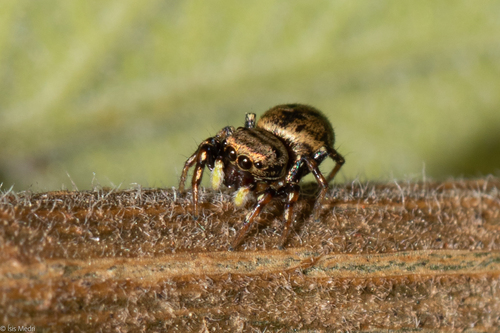
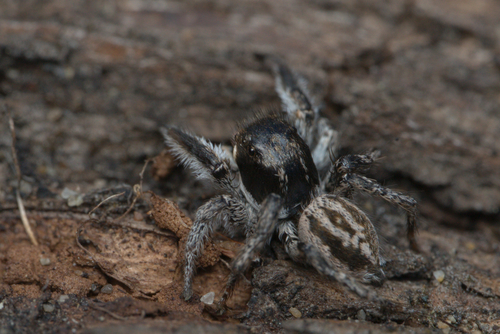
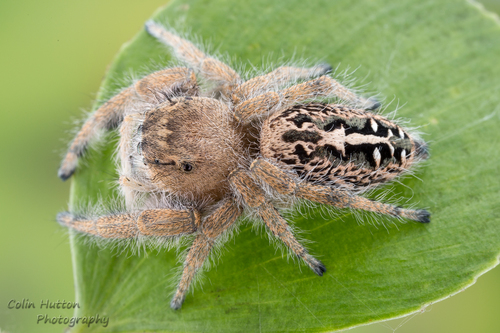
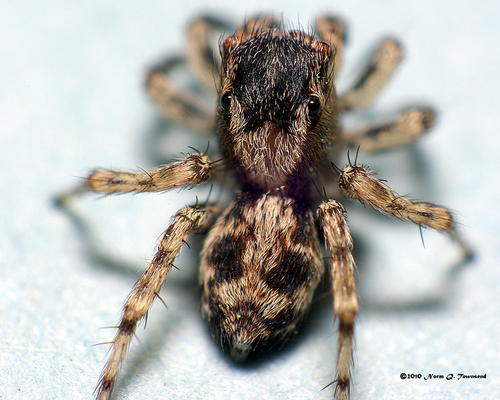
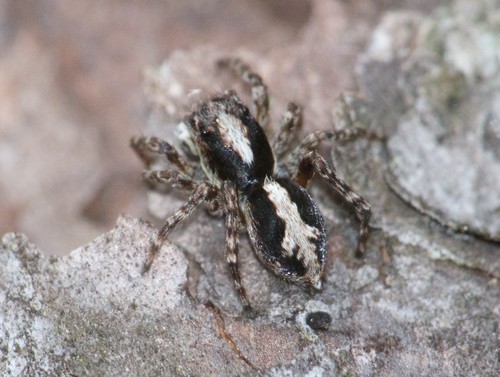
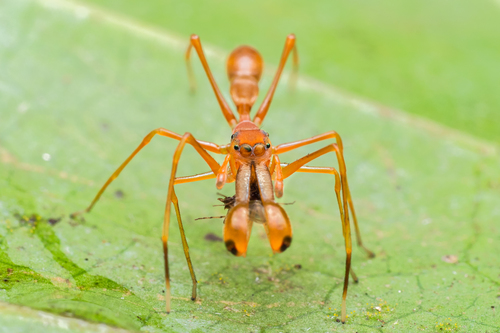
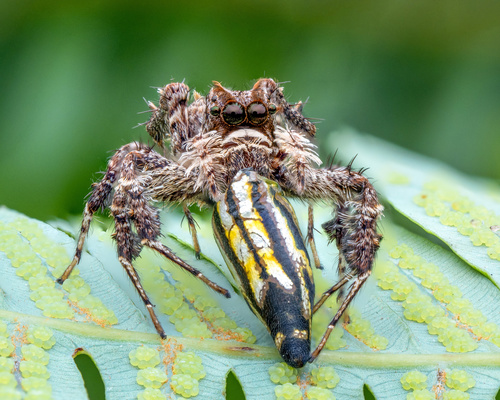
Portia labiata is a medium-sized jumping spider belonging to the family Salticidae. Its distribution range includes Sri Lanka, India, southern China, Burma (Myanmar), Malaysia, Singapore, Java, Sumatra and the Philippines. The front section of its body is orange-brown, while the back section is brownish. Its large main eyes deliver daytime vision more acute than a cat's, and 10 times more acute than a dragonfly's, which is critical for the species' navigation, hunting and mating. The entire Portia genus is nicknamed "eight-legged cats" because all its members have versatile, adaptable hunting tactics similar to a lion's. All Portia have instinctive hunting strategies for their most common prey, but they can often improvise new approaches through trial and error when encountering unfamiliar prey or new situations, and remember these new methods later. Unlike most jumping spiders, which mainly hunt insects through active pursuit, female Portia including P. labiata also build webs to catch prey directly, and sometimes attach their webs to the webs of other web-building spiders. Both male and female P. labiata prefer to hunt web spiders as prey, followed by other jumping spiders, and finally insects. In all hunting scenarios, female P. labiata are more effective predators than males. Two P. labiata populations from the Philippines, one from Los Baños and one from Sagada, have slightly different hunting tactics. In laboratory tests, Los Baños P. labiata rely more on trial and error than Sagada P. labiata when learning how to vibrate prey webs to lure or distract prey. Near Los Baños, the web-building jumping spider predator Scytodes pallida, which spits sticky gum at prey and potential threats, is very abundant. P. labiata from this region instinctively detour to the back of S. pallida while plucking the web to make S. pallida think the threat is in front of it. Local P. labiata do not use this combination of deception and back-stabbing detouring in areas where S. pallida does not exist. To test P. labiata's ability to solve new problems, researchers set up a miniature lagoon and observed how spiders crossed it. Sagada P. labiata from the mountains almost always repeated their first attempted crossing method, even when that attempt failed. When Los Baños P. labiata, found near a lake, failed their first attempt, around three-quarters switched to a different crossing method. Adult P. labiata sometimes use propulsive displays, where an individual threatens a same-sex rival; unreceptive females also use this display to threaten males. Female P. labiata are extremely aggressive toward other females, often attempting to invade and take over each other's webs, and these conflicts frequently result in cannibalism. Testing shows they reduce confrontation risk by using silk draglines as territory marks. Additional testing confirms females can recognize the draglines of the most powerful fighters, and prefer to stay closer to the draglines of less powerful fighters. Females often attempt to kill and eat their mates during or after copulation, while males use tactics to survive mating, though females sometimes outwit males. Before they are mature enough to mate, juvenile females mimic adult females to attract males as prey. When hunting, mature female P. labiata release olfactory signals that reduce the chance other conspecific females, males or juveniles will compete for the same prey. Before courtship begins, a male P. labiata spins a small web between branches or twigs, hangs underneath it, and ejaculates onto the web. He then soaks the semen into reservoirs on his pedipalps, which are larger than the pedipalps of females. Like many other spider species, P. labiata females release volatile pheromones into the air that generally attract males from a distance. The silk draglines of female jumping spiders also contain pheromones, which stimulate males to court females and may carry information about each female's status, such as whether the female is juvenile, subadult or mature. Pheromones may also help locate jumping spider nests, which are usually hidden under rocks or inside rolled leaves and are difficult to spot. A propulsive display consists of a series of sudden, fast movements including striking, charging, ramming and leaps. A laboratory test found that male P. labiata reduce the risk of encountering each other by recognizing fresh silk draglines, both their own and those of other males. Males are also attracted to fresh blotting paper that holds female draglines, while females do not respond to fresh blotting paper holding male draglines. This indicates males usually search for females, rather than the reverse. Neither sex responded to one-week-old blotting paper, regardless of whether it held male or female draglines. Similar tests on P. fimbriata from Queensland show the same response patterns between sexes. When adult P. labiata of opposite sexes recognize each other, they start displaying when they are 10 to 30 centimeters apart. Males typically wait 2 to 15 minutes before starting a display, but sometimes a female initiates the display first. When a female P. labiata sees a male, she may approach slowly or wait. The male then walks with his body erect, and displays by waving his legs and palps. If the female does not run away, she will give a propulsive display first. If the male stands his ground and the female does not run away or repeat the propulsive display, the male approaches, and the pair copulates if the female is mature. If the female is sub-adult (one moult away from maturity), the male may cohabit in the female's capture web. Portia species usually mate on a web or on a dragline made by the female. P. labiata typically copulates for around 100 seconds, while members of other genera can take several minutes or even several hours. As noted earlier, female P. labiata attempt to kill and eat their mates during or after copulation via twisting and lunging. Males wait to approach until females have hunched their legs, which makes an attack less likely. Males also try to abseil down from a silk thread to approach from above, but females may manoeuvre to gain the higher position. If the female makes any movement, the male leaps away and flees. As noted earlier, juvenile females that are not yet mature enough to mate mimic adult females to attract males as prey. Also as noted earlier, female P. labiata are extremely aggressive toward other females, and conflicts over webs often end in cannibalism. Laboratory tests confirm female P. labiata reduce the risk of confrontation by recognizing draglines on blotting paper, both their own draglines and those of other P. labiata females. When obstacles block visibility to confirm whether another female is actually present, a female avoids blotting paper that holds another female's dragline, but moves freely if she can see no other female is present. Draglines act as territory marks, similar to how many mammals use scent marking to signal presence to other members of their species. Female P. labiata also avoid rival females with higher fighting ability, and spend more time near less powerful fighters. In one laboratory test, researchers collected draglines from equal-sized females, then pitted some of those females in contests. Other uncontested females avoided the draglines of contest victors, and spent most of their time on the draglines of contest losers. Similar tests found that females of P. fimbriata from Australia and P. schultzi from Kenya do not avoid the draglines of powerful fighters. For P. labiata and some other Portia species, contests between males usually only last 5 to 10 seconds, and only their legs make contact during these contests. Contests between Portia females are violent, and grappling encounters between P. labiata females typically last 20 to 60 seconds. These occasionally include grappling that can break a leg, but more often one female lunges at the other. Sometimes one female knocks the other onto her back, and the flipped female may be killed and eaten if she cannot right herself and run away quickly. If the loser has a nest, the winner takes over the nest and eats any eggs inside it. As noted earlier, when hunting, mature female P. labiata and several other Portia species emit olfactory signals that reduce competition for the same prey from other conspecifics of any sex or age. This effect inhibits aggressive mimicry against a prey spider even when the prey is visible, and also works when the prey lives in any section of a web. If a female of one of these Portia species smells a conspecific male, the female stimulates the male to court. These Portia species do not show this behaviour when they receive olfactory signals from members of other Portia species. P. labiata usually lays eggs on dead, brown leaves around 20 millimetres long, suspended near the top of the female's capture web, then covers the eggs with a sheet of silk. If no dead leaf is available, the female will build a small horizontal silk platform in her capture web, lay the eggs on the platform, then cover the eggs. Portia females have never been observed eating their own eggs, but wild females with their own eggs have been observed eating eggs from other conspecific females. In one test, P. labiata females did not eat their own eggs even when researchers placed those eggs in other females' nests, which shows test females can identify their own eggs, likely through chemical cues. When test females and their own eggs were returned to the females' original nests, and other females' eggs were also placed in the same nest, the test female ate neither her own eggs nor the foreign eggs. In nature, a female is unlikely to find foreign eggs in her own nest, so it may be safest for females to avoid any eggs in their nests. For moulting, all Portia species spin a horizontal web with a diameter around twice the spider's body length, suspended just 1 to 4 millimetres below a leaf. The spider lies head down, and often slides 20 to 30 millimeters down during moulting. Portia species spin a similar temporary web for resting. The two Philippine populations of P. labiata live in different environments: Los Baños is a low-lying tropical rainforest with many spider species, some of which are particularly dangerous to P. labiata; Sagada is at higher altitude, with pine forest and fewer spider species, none as dangerous to P. labiata as the dangerous species found in Los Baños. The Los Baños population variant has a slightly wider range of hunting tactics. In the Philippines, P. labiata does not hunt ants, but is preyed on by the ants Oecophylla smaragdina and an uncertain Odontomachus species; a solitary Odontomachus ant has been observed attacking a P. labiata. In laboratory tests, the ant Diacamma vagans usually kills a single P. labiata on its own.