About Portia fimbriata (Doleschall, 1859)
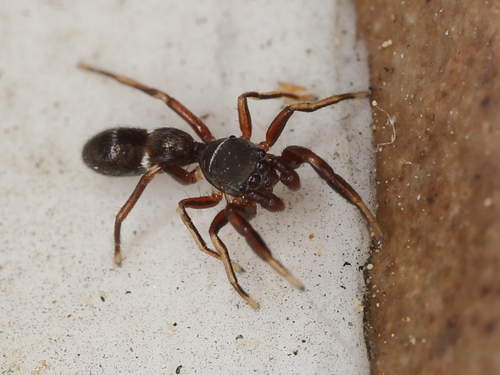
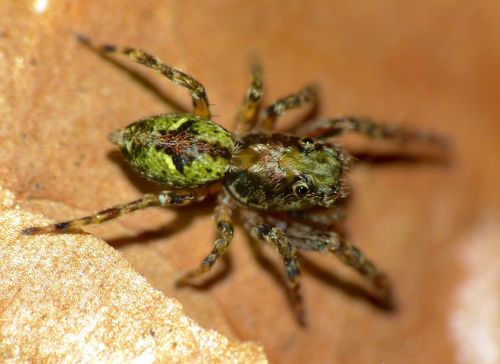
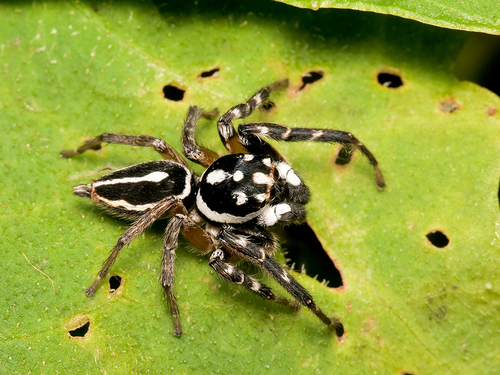
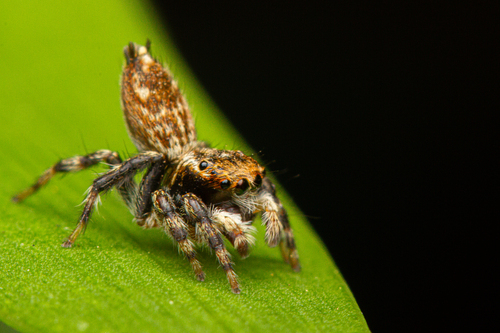
Portia fimbriata, sometimes called the fringed jumping spider, is a jumping spider belonging to the family Salticidae. This species is found in Australia and Southeast Asia. Adult females have body lengths ranging from 6.8 to 10.5 millimetres, while adult males measure between 5.2 and 6.5 millimetres long. For most populations, both sexes have a generally dark brown carapace, reddish brown chelicerae (called "fangs"), a brown underside, dark brown palps covered with white hairs, and dark brown abdomens with white spots on the upper side. Both sexes also have fine, faint markings and soft fringes of hair, along with spindly, fringed legs. However, specimens from New Guinea and Indonesia have orange-brown carapaces and yellowish abdomens. Across all species in the genus Portia, the abdomen distends when the spider is well fed or producing eggs. The hunting tactics of Portia jumping spiders are versatile and adaptable. All Portia members have instinctive hunting tactics for their most common prey, but can improvise through trial and error against unfamiliar prey or in unfamiliar situations, and then remember the new approach. There are clear differences in hunting tactics between regional populations of P. fimbriata. P. fimbriata from Australia's Northern Territory are poor at hunting other jumping spiders, and perform better when hunting non-salticid web-building spiders and insects. The Sri Lankan variant is moderately effective against other jumping spiders, and good against web spiders and insects. P. fimbriata from Queensland is an outstanding predator of both other jumping spiders and web spiders, but poor against insects. The Queensland variant uses a unique "cryptic stalking" technique that prevents most jumping spider prey from identifying P. fimbriata as a predator, or even as an animal at all. Some jumping spider prey have partial defences against this cryptic stalking technique. All types of prey spiders occasionally counter-attack, but all Portia species have very good defences, starting with especially tough skin. When P. fimbriata encounters another individual of the same species, it does not use cryptic stalking; instead, it displays by moving quickly and smoothly. For Queensland P. fimbriata, contests between males are usually very brief and cause no damage. Contests between Portia females are usually long and violent, and the victor may evict the loser and then eat the loser's eggs – but victorious Queensland P. fimbriata females do not kill and eat the losing female. If a Queensland P. fimbriata male displays to a female, she may run away or charge at him. If the pair reach agreement after this interaction, they will copulate if she is mature; if she is sub-adult, he will cohabit in her nest until she finishes moulting, and then they copulate. P. fimbriata typically copulates much more quickly than other jumping spiders. Unlike in other Portia species, female P. fimbriata do not eat their mates during courting, nor during or after copulation. Before courtship begins, a male Portia spins a small web between boughs or twigs, hangs under it, and ejaculates onto the web. He then takes up the semen into reservoirs in the palpal bulbs on his pedipalps. A laboratory test of Queensland P. fimbriata males showed that they minimise the risk of encountering each other by recognising fresh blotting paper that holds either their own silk draglines or another male's draglines. Males were also attracted to fresh blotting paper containing females' draglines, while females do not respond to fresh blotting paper containing males' draglines. This suggests that males usually search for females, rather than the reverse. Neither sex responded to one week-old blotting paper, regardless of whether it contained draglines from males or females. When encountering another member of the same species, P. fimbriata does not stalk, but displays by moving quickly and smoothly at a distance of 4 to 27 centimetres. It raises its legs, sways its body from side to side, and lowers its palps below its chelicerae ("fangs"). This display behaviour is very different from the stalking it uses when encountering another salticid of a different species, even when both receive the same visual stimulus: the sight of the other's large anterior-median eyes. Although P. fimbriata is influenced by pheromones much more strongly than is typical for salticids, visual cues alone are enough to trigger displays and allow P. fimbriata to distinguish members of its own species from other salticids, even when neither partner moves. The spindly, fringed legs of Portia species may help identify members of the same species, as well as concealing these spiders from other salticid species. For Queensland P. fimbriata, contests between males usually last only 5 to 10 seconds, and only their legs make contact during these contests. Contests between Portia females are usually long and violent, and for Queensland P. fimbriata these contests often involve grappling that sometimes breaks a leg. A victor may evict the loser, eat the loser's eggs, and take over the loser's web. Unlike in some other Portia species, victorious Queensland P. fimbriata females do not kill and eat the losers. When a female spots a male, she may approach slowly or wait. The male then walks erect and displays by waving his legs and palps. If the female does not run away, she gives a "propulsive display" first. If the male stands his ground and the female does not run away or repeat the propulsive display, he approaches, and if she is mature, they copulate, with the male inserting the tip of one of his palpal bulbs into the female's copulatory opening, using the first palp that made scraping contact. If the female is sub-adult (one moult away from maturity), a male (or sometimes a sub-adult male) of P. fimbriata may cohabit in the female's capture web. Portia species usually mate on a web or on a dragline made by the female. P. fimbriata typically copulates for about 100 seconds, while jumping spiders from other genera can take several minutes or even several hours to copulate. Unlike in some other Portia species, Queensland P. fimbriata females do not eat their mates during courting, nor during or after copulation. When hunting, mature females of P. fimbriata, P. africana, P. labiata, and P. schultzi emit olfactory signals that reduce the risk that any other females, males or juveniles of the same species will contend for the same prey. This effect inhibits aggressive mimicry against a prey spider even when the prey spider is visible, and also when the prey lives in any part of a web. If a female of one of these Portia species smells a male of the same species, the female stimulates the male to court. These Portia species do not show this behaviour when they receive olfactory signals from members of other Portia species. In laboratory tests, Portia species including P. fimbriata will mate with other species, but the females produce no eggs after such matings. Queensland P. fimbriata prefers to lay eggs on dead, brown leaves about 20 millimetres long, suspended near the top of its capture web, and then covers the eggs with a sheet of silk. If no dead leaf is available, the female will make a small horizontal silk platform in the capture web, lay the eggs on it, and then cover the eggs. For Northern Territory P. fimbriata, females occasionally lay eggs in a dead leaf, but more usually lay eggs in a silk egg sac on a small horizontal web suspended on the main web. Like all arthropods, spiders moult, and after hatching, the life stage before each moult is called an "instar". P. fimbriata specimens become mature at instar 7, 8 or 9. In an experiment using Queensland P. fimbriata spiderlings, 64% of spiderlings fed only on spiders survived to maturity, 37% of those fed a mixture of spiders and insects survived, and all spiderlings fed solely on insects died before reaching the 6th instar. For moulting, all Portia species spin a horizontal web whose diameter is about twice the spider's body length, suspended only 1 to 4 millimetres below a leaf. The spider lies head down, and often slides down 20 to 30 millimetres during moulting. Portia species spin a similar temporary web for resting. Queensland P. fimbriata can be very sedentary, and in some cases remains in the same web for over 48 days during a series of moults. P. fimbriata is found in the rain forests of India, Nepal, Sri Lanka, Hong Kong, Taiwan, New Guinea, the Solomon Islands, Malaysia (including Malacca), Indonesia, and in Australia's Northern Territory and Queensland. It lives on foliage, tree trunks, boulders, and rock walls. Throughout its range, this is the most common species of the genus Portia. Queensland P. fimbriata specimens live near running water in areas with moderate light, while Northern Territory specimens live in caves where light levels range from rather dark at the cave back to much brighter around the cave mouths. Other Portia populations also live in areas with higher light levels than Queensland, and some members of these other populations are found in webs exposed to direct sunlight for part of the day. In Queensland, P. fimbriata shares its habitat with an abundant common prey species, Jacksonoides queenslandicus, along with large populations of other non-Portia salticids and non-salticid web-building spiders. Ants prey on P. fimbriata, and P. fimbriata does not stalk ants, considering them poisonous or very unpleasant. P. fimbriata is also preyed upon by birds, frogs, and mantises. P. fimbriata is often difficult to find in the wild, because its shape and movements are well camouflaged. The Queensland variety is quite easy to raise in captivity, while the Northern Territory variety is quite troublesome to maintain.