About Porpolomopsis lewelliniae (Kalchbr.) Lodge, Padamsee & S.A.Cantrell
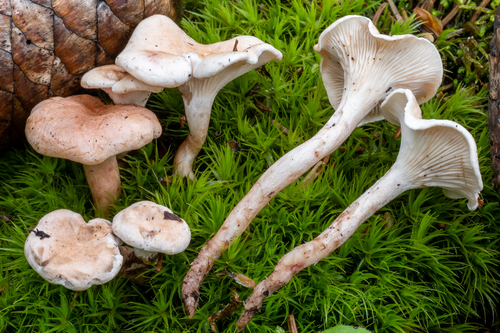
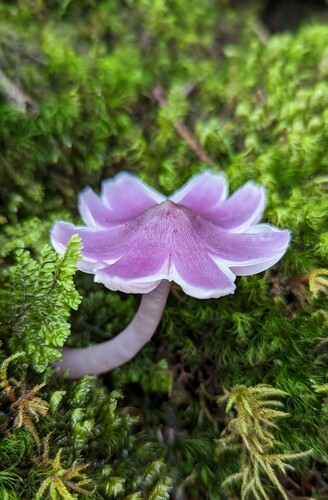
Commonly called the mauve splitting waxcap, Porpolomopsis lewelliniae is a small mushroom. Its cap is 3–6.5 centimetres (1+1⁄3–2+1⁄2 inches) in diameter, is umbonate, starts out conical, and later flattens into an almost flat shape. The cap is smooth, colored mauve or lilac with a greyish central boss, and textured with radial fibers; it may split along these fibers, and the gills divide within the split. The lilac stipe is 3–7 cm (1+1⁄3–2+1⁄2 in) high and 0.4–0.8 cm thick, and may have a yellow tinge at its base. The lilac gills are either adnexed or free, they are thick or widely spaced with even margins. This species produces a white spore print; its hyaline spores are roughly oval, and measure around 5.5 by 9 μm. Porpolomopsis lewelliniae is a saprotrophic species that is fairly common. Its fruiting bodies grow in autumn and winter, which corresponds to March to August, with some records of growth in October. They grow in moss or among leaf litter in wet sclerophyll forest or rainforest located in temperate, subtropical, or tropical climates, and can also be found growing in sandy areas. It has been recorded from southeastern Queensland, eastern New South Wales, Victoria and Tasmania in Australia, as well as New Zealand and Mount Kinabalu in Sabah. While it has not been officially recorded from North Queensland, it is predicted to grow there.