About Porpolomopsis calyptriformis (Berk.) Bresinsky
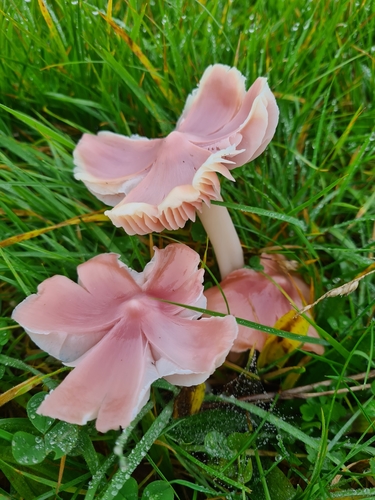
The basidiocarps of Porpolomopsis calyptriformis are agaricoid. The cap is narrowly conical when young, and retains an acute umbo once it expands. Fully expanded caps can grow up to 7.5 centimetres (3 in) across, often split when expanded, and have upward-turning margins. The cap surface is smooth to fibrillose, slightly shiny or greasy, and ranges in colour from pale rose-pink to lilac-pink; it is rarely white. The lamellae (gills) are widely spaced and waxy, and match the cap colour or are whiter than the cap. The stipe (stem) grows up to 16 cm (6+1⁄4 in) long, is smooth, white to a pale version of the cap colour, and lacks a ring. The spore print is white. When viewed under a microscope, the spores are smooth, inamyloid, and ellipsoid, measuring approximately 6.5 to 8.0 by 4.5 to 5.5 μm. This species can usually be identified in the field based on its unique shape and colour: no other European waxcap has a pink colour and a pointed cap.
In terms of distribution and habitat, Porpolomopsis calyptriformis, commonly called the Pink Waxcap, is widespread but generally rare across Europe, with its main population stronghold in the United Kingdom where it is not uncommon. Like other waxcaps, it grows in old, agriculturally unimproved short-sward grassland such as pastures and lawns. It has been reported from North America, but all DNA-sequenced North American specimens do not match the European P. calyptriformis. Recent research indicates that waxcaps are neither mycorrhizal nor saprotrophic, and may be associated with mosses. The species is reportedly edible.