About Porphyrio melanotus Temminck, 1820
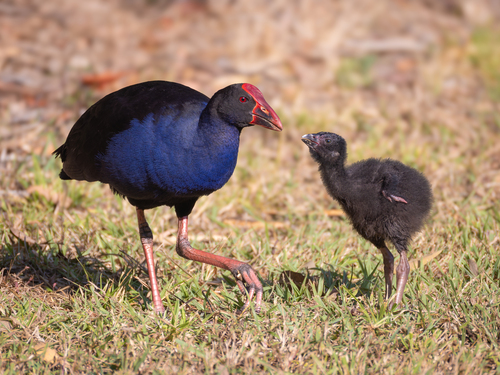
Description: Australasian swamphens are long-legged birds that stand approximately 51 cm tall. They have dark plumage, black upperparts, and a contrasting white undertail. They feature a large, bright red bill and an expanded frontal shield that extends from their culmen, creating a distinctive look. Their throat and breast are purple, which adds to their striking color pattern. There are size and color variations across different subspecies, depending on the region; some subspecies have greener or bluer upperparts, while others are smaller in body size. The New Zealand population, along with green-yellow swamphens in Tasmania, are possibly slightly larger than birds from mainland Australia, but are otherwise identical to them. Distribution: The Australasian swamphen is found in mainland Australia, eastern Indonesia, the Moluccas, the Aru and Kai Islands, and Papua New Guinea. It also occurs on the main islands of New Zealand, as well as the Chatham Islands and Kermadec Islands. Habitat: The Australasian swamphen primarily lives in swamps and marshes across Southeast Asia, Australia, and New Zealand. In New Zealand, these birds flourish in wet lowlands and breed in swamps, but they also use a range of other habitats including pastures, crops, farm ponds, road verges, and forest margins. This adaptability has allowed them to take advantage of new feeding opportunities that developed after large-scale lowland clearance and swamp drainage over the past 150 years. The swamphen is typically found in low-lying wetlands that have vegetation such as flax, raupo, and rushes, and it is also common in estuaries, salt marshes, and along riverbanks. Their large feet let them move across swampy terrain without sinking; while the feet are not webbed, they still provide enough propulsion for swimming. Australasian swamphens are also known for their speed, making them swift runners across their varied habitats.