About Porphyrio martinica (Linnaeus, 1766)
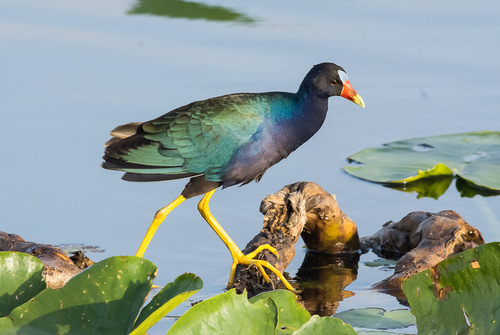
The purple gallinule (Porphyrio martinica) is a medium-sized rail. It measures 26–37 cm (10–15 in) in length, has a 50–61 cm (20–24 in) wingspan, and weighs 141–305 g (5.0–10.8 oz). On average, males are slightly larger than females, with an average mass of 257 g (9.1 oz) compared to the female average of 215 g (7.6 oz). Adult purple gallinules have purple-blue plumage that shines green and turquoise in good lighting. They also have a pale blue shield on the forehead, which connects to their red and yellow bill. In low light or darkness, the adult’s bright purple-blue plumage appears dimmed, looking dusky or brownish, but the color of the forehead shield distinguishes this species from similar birds like common gallinules. Immature purple gallinules are brown-bronze, with purple feathers on the chest, and have a pale-colored bill and forehead shield. Juvenile birds are light brown, with subtle green-bronze tones on the wings and back, and have white under-tail coverts. Purple gallinules have long toes that distribute their weight across a large surface area, letting them walk on floating vegetation. They also have an anisodactyl toe arrangement that helps them cling to plant stems. Adult purple gallinules have bright yellow legs and feet, immatures have brown-yellowish legs and feet, and juveniles have brown legs and feet. When they fly, their legs hang down, and they typically only fly short distances. During the breeding season, these birds are found in the southeastern United States. They are permanent residents in southern Florida, the Gulf and Pacific coast of Mexico, parts of Central America, and the Caribbean. In the non-breeding season, they occur more inland across parts of Central America. They can also be found in South America during migration, and stray individuals sometimes reach as far north as Canada. This species has the most extensive vagrancy pattern among all rails. Individuals have been recorded as far west as California and the Galápagos Islands, as far north as Iceland and Labrador, as far south as Tierra del Fuego, and as far east as Great Britain, Portugal and Cape Verde. It has been recorded 21 times in Cape Province, South Africa; most of these recorded birds were juveniles, so it is very unlikely that a breeding population will become established there. The species’ preferred habitat is freshwater marsh with dense stands of vegetation. Purple gallinules are omnivorous ground feeders with a diet that includes a wide variety of plant and animal material. Their consumed foods include seeds, leaves, and fruits of both aquatic and terrestrial plants, plus insects, insect larvae, spiders, other invertebrates, frogs, snails, earthworms, and fish. They are also known to prey on the eggs and young of other bird species, such as the jacana.