About Populus trichocarpa Torr. & A.Gray ex Hook.
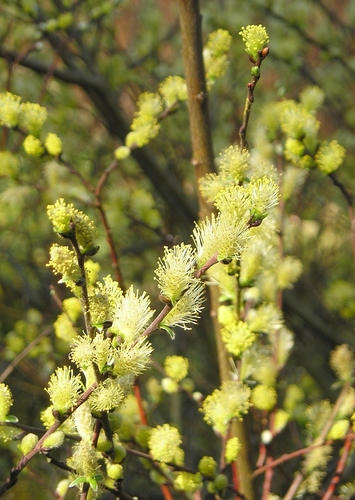
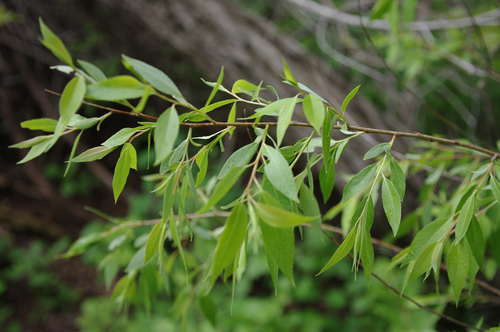
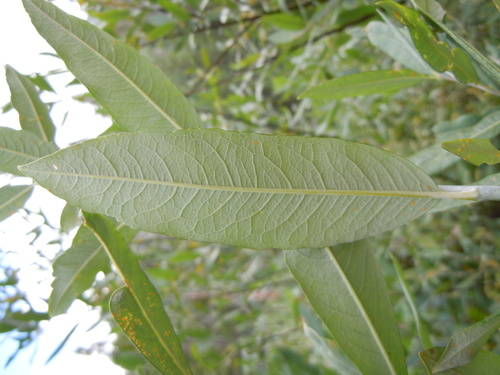
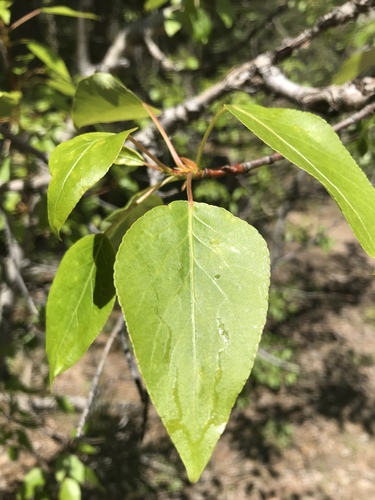
Populus trichocarpa Torr. & A.Gray ex Hook. is a large tree that grows 30 to 50 m (98 to 164 ft) tall, with a trunk diameter over 2 m (6+1⁄2 ft). It ranks 3rd among poplar species in the American Forests Champion Tree Registry. It is normally fairly short-lived, but some individuals may live up to 400 years. A black cottonwood growing in Willamette Mission State Park near Salem, Oregon, holds both national and world records for the species; when last measured in April 2008, this tree stood 47 m (155 ft) tall, measured 8.8 m (29 ft) around, and scored 527 points. Its bark is grey and covered with lenticels, becoming thick and deeply fissured on old trees, and hard enough to produce sparks when cut with a chainsaw. Older stem sections are grey, while younger stem sections are light brown. The crown is usually roughly conical and quite dense, and lower branches of large trees droop downwards. Spur shoots are common on this species. Its wood is light-colored and has a straight grain. Leaves are typically 7–20 centimetres (2+3⁄4–7+3⁄4 in) long, with a glossy dark green upper side and a glaucous light grey-green underside; larger leaves, up to 30 cm (11+3⁄4 in) long, may grow on stump sprouts and very vigorous young trees. Leaves are alternate, elliptical with a crenate margin and an acute tip, and have reticulate venation. Leaf petioles are reddish. Buds are conical, long, narrow, and sticky, and release a strong balsam scent when they open in spring. This species has an extensive, aggressive root system that can invade and damage drainage systems; roots may even damage building foundations by drying out surrounding soil. In 2016, the first published direct evidence confirmed that wild P. trichocarpa fixes nitrogen. The genome of P. trichocarpa is 485 million base pairs long, compared to the 3 billion base pairs of the human genome. The proportion of heterochromatin to euchromatin in its genome is 3:7, it has 19 chromosomes, and a September 2008 estimate placed its number of putative genes at 45,555, the largest number of genes ever recorded at that time. Its mitochondrial genome is 803,000 base pairs long and contains 52 genes, while its chloroplast genome is 157,000 base pairs long and contains 101 genes. The native range of P. trichocarpa covers large areas of western North America. It extends from Kodiak Island and Cook Inlet in Southeast Alaska to latitude 62° 30' N, through British Columbia and the forested areas of Washington and Oregon, to the mountains of southern California and northern Baja California at 31°N. It also grows inland, generally on the west side of the Rocky Mountains in British Columbia, southwestern Alberta, western Montana, and north-to-central Idaho. Scattered small populations have been recorded in southeastern Alberta, eastern Montana, western Wyoming, Utah, and Nevada. Black cottonwood grows on alluvial sites, in riparian habitats, and in moist woods on mountain slopes, from sea level up to elevations of 2,100–2,750 m (6,890–9,020 ft). It often forms extensive stands on the bottomlands of major streams and rivers at low elevations along the Pacific Coast, west of the Cascade Range. In eastern Washington and other dry areas, it is restricted to protected valleys and canyon bottoms, along streambanks, and at the edges of ponds and meadows. It grows on a wide range of soil types, from moist silts, gravels, and sands to rich humus, loams, and occasionally clays. Black cottonwood is a pioneer species that grows best in full sunlight and commonly establishes on recently disturbed alluvium. It produces numerous seeds that are widely dispersed by their cottony tufts, which allows the species to colonize burn sites if establishment conditions are met. Seral communities dominated or codominated by cottonwood are maintained by periodic flooding or other types of soil disturbance. Black cottonwood has low drought tolerance, is flood-tolerant, and cannot tolerate brackish water or stagnant pools. P. trichocarpa has been one of the most successful tree introductions to the otherwise almost treeless Faroe Islands. The species was imported from Alaska to Iceland in 1944, and has since become one of the most widespread trees in Iceland. Due to its high levels of rooting hormones, P. trichocarpa sprouts readily. After logging operations, it sometimes regenerates naturally from rooting of partially buried branch fragments or from stumps. Sprouting also occurs from existing roots. The species can also abscise fully intact shoots that still bear green leaves. These fallen shoots drop to the ground, and may root where they land or be dispersed by water. In some environments, this abscission can act as a method to colonize exposed sandbars. P. trichocarpa is the most populous cottonwood of the Pacific Northwest, and hybridizes with the region's three other cottonwood species: balsam poplar, plains cottonwood, and narrowleaf cottonwood. All four species have similar appearances and provide habitat for a variety of animals. Cottonwoods are shade intolerant. Black cottonwood thrives by colonizing disturbed sites, but can eventually be replaced by conifers. Its wood is relatively weak and waterlogged, often splitting during freezes, and is also susceptible to rot. Woodpeckers create cavities in this tree that various other animals use for nesting, and larger birds build their nests on the large upper branches of the tree. Beavers use P. trichocarpa trees as a food source and for dam building. It is grown as an ornamental tree, valued for its fast growth and spring scented foliage, which can be detected from over 100 m away. However, its roots are invasive, and can damage the foundations of buildings on shrinkable clay soils if the tree is planted nearby (Mitchel 1996). Branches of this species can be added to potted plants to stimulate rooting. This tree has also been used for medicinal purposes. The Squaxin people used its bark to treat sore throats and tuberculosis, and mixed water with bruised bark to make an antiseptic mixture. The Klallam people used its buds to make an eye treatment. The Quinault people extracted gum from its burls and applied this gum to skin cuts.