About Populus tremuloides Michx.
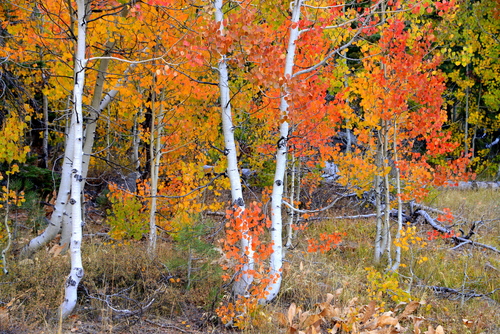
Quaking aspen (Populus tremuloides Michx.) is a tall, fast-growing tree that typically reaches 15–18 meters (50–60 ft) in height at maturity, with a trunk 25 centimeters (10 in) in diameter. Record specimens have reached 36.5 m (119 ft 9 in) in height and 1.37 m (4 ft 6 in) in diameter. Its bark is relatively smooth, whitish (light green when young), marked with thick black horizontal scars and prominent black knots. Parallel vertical scars on bark are a distinct sign of elk, which strip aspen bark with their front teeth.
Mature trees bear nearly round leaves 4–6 cm (1+1⁄2–2+1⁄4 in) across, with small rounded teeth and 3–7 cm (1+1⁄4–2+3⁄4 in) long flattened petioles. Leaf surfaces are green above and gray below. Young trees and root sprouts produce much larger, nearly triangular leaves that are 10–20 cm (4–8 in) long. Some Populus species have petioles flattened partially along their length, while aspens and some other poplars have petioles flattened from side to side along their entire length.
Quaking aspens are dioecious, meaning separate male and female clones make up populations. Their flowers are 4–6 cm (1+1⁄2–2+1⁄4 in) long catkins, produced in early spring before leaves emerge. The fruit is a 10 cm (4 in) long pendulous string of 6-millimeter (1⁄4 in) capsules; each capsule holds around ten tiny seeds embedded in cottony fluff, which aids wind dispersal when seeds mature in early summer. Trees can start producing seed as young as 2–3 years old, but significant seed production does not begin until 10 years of age, with the best seed production occurring between 50 and 70 years old.
This species grows more slowly and lives longer in the dry conditions of western North America than in the more humid eastern part of the continent. Ages of 80–100 years are typical in the west, and some individuals live up to 200 years, while the root system can survive much longer. In eastern North America, stands decay faster, sometimes within 60 years or less depending on the region.
Quaking aspen is distributed across all Canadian provinces and territories, with the possible exception of regions of Nunavut north of the James Bay islands. In the United States, it grows as far north as the northern foothills of Alaska's Brooks Range, where it occupies well-drained habitat on road margins and gravel pads in a region where permafrost usually keeps soils waterlogged. It occurs at low elevations as far south as northern Nebraska and central Indiana. In the Western United States, this tree rarely survives at elevations lower than 1,500 feet (460 m) due to hot summers below this elevation, and is generally found between 5,000–12,000 feet (1,500–3,700 m). It grows at high elevations as far south as Guanajuato, Mexico, and also occurs in isolated areas of northeastern Mexico, Baja California, Jalisco, the State of Mexico, Michoacán, Sinaloa, Sonora, and Veracruz.
This species tolerates a very wide range of climatic conditions. Average January and July temperatures range from −30 °C (−22 °F) and 16 °C (61 °F) in Alaska Interior to −3 °C (27 °F) and 23 °C (73 °F) in Fort Wayne, Indiana. Average annual precipitation ranges from 1,020 mm (40 inches) in Gander, Newfoundland and Labrador to as little as 180 mm (7 inches) in the Alaska Interior. The southern limit of the species' range roughly follows the 24 °C (75 °F) mean July isotherm. In the sagebrush steppe, quaking aspen grows alongside chokecherry, serviceberry, and hawthorn, forming sheltered habitat that supports animal life. Shrub-like dwarf clones grow in marginal environments too cold and dry to support full-size trees, for example at the species' upper elevation limits in the White Mountains.
Quaking aspen reproduces primarily through root sprouts, and forms extensive clonal colonies. Each colony is a single clone: all trees in the colony share identical characteristics and a single connected root system. A clone will often change fall color earlier or later than neighboring aspen clones. Fall foliage is usually bright yellow, with occasional red blushes in some regions. Since all trees in a clonal colony are part of one single organism, one famous colony named Pando is considered the heaviest and oldest known living organism on Earth. Pando covers 43 hectares and weighs an estimated six million kilograms. Most scientists agree Pando's original seed took root between 8,000 and 12,000 years ago, when regional climate changed at the end of the last ice age.
Although quaking aspens do produce seeds, they rarely grow from seed. Pollination is limited because aspens are single-sex, and large stands are usually all clones of the same sex. Even when pollination occurs, the tiny seeds (around three million per pound) are only viable for a short time, as they lack stored food reserves and a protective coating.
Buds and bark of quaking aspen provide food for snowshoe hares, moose, black bears, cottontail rabbits, porcupines, deer, grouse, and mountain beavers. Shoots are eaten by sheep, goats, and cattle. Sheep, goats, and game animals including elk also browse the foliage. Grouse and quail rely heavily on aspen buds for winter food. Mammals including beavers and rabbits eat bark, foliage, and buds; beavers also store aspen logs for winter food. Many other animals nest in aspen groves. Leaves of quaking aspen and other Populus species serve as food for caterpillars of many moth and butterfly species. Quaking aspen also hosts certain damaging insects, such as the large aspen tortrix.
Aspen bark contains a substance that indigenous North Americans and European settlers of the western U.S. extracted for use as a quinine substitute. Like other poplars, aspen makes poor fuel wood because it dries slowly, rots quickly, and does not produce much heat. Despite this, it is still widely used in campgrounds because it is cheap, plentiful, and not commonly used for building lumber. Pioneers in the North American west used aspen to build log cabins and dugouts, though it was not the preferred timber species. Aspen wood is primarily used for pulp products in Canada, including books, newsprint, and fine printing paper. It is especially well-suited for panel products such as oriented strand board and waferboard. It is lightweight, and is also used for furniture, boxes and crates, core stock in plywood, and wall panels.
Quaking aspen is the state tree of Utah. The cultivar 'Prairie Gold' was introduced to the plant trade by the Nebraska Statewide Arboretum and a local nursery, which states it is better adapted to the warmer conditions and lower humidity of lower elevations. This cultivar is only rated hardy to USDA zone 4; most cultivated quaking aspens are hardy in USDA zones 1 to 6. Cultivated aspens require good drainage and moist or occasionally wet soils. Where drainage is good, they adapt to clay, silt, sand, or shallowly rocky soils.