About Populus euphratica Olivier
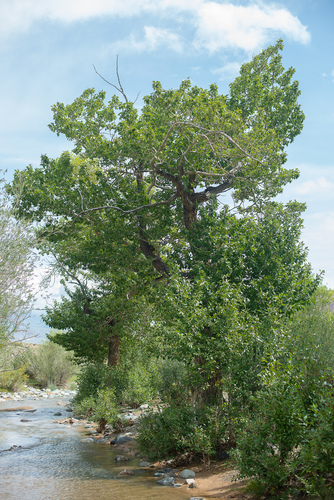
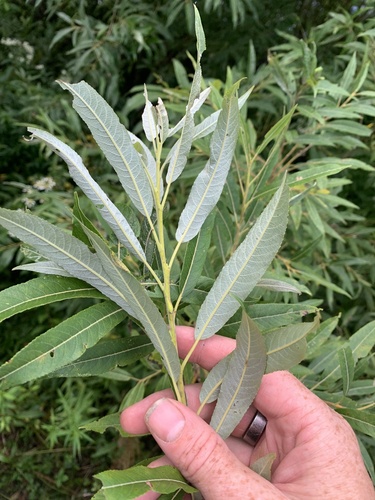
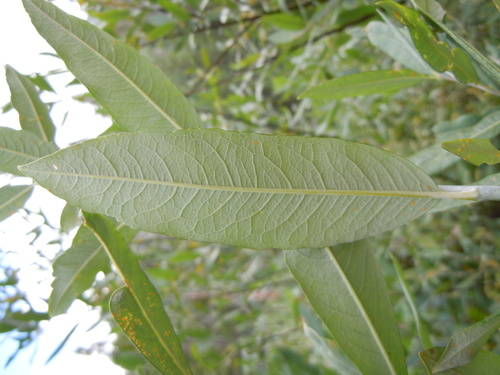
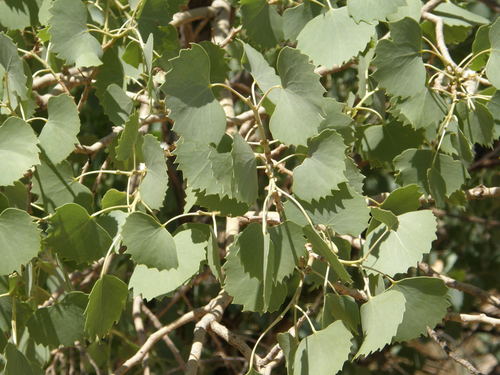
Populus euphratica Olivier, commonly known as Euphrates poplar, is a medium-sized deciduous tree. Under favorable growing conditions, it can reach around 15 meters (49 feet) in height, with a trunk girth of 2.5 meters (8.2 feet). Mature stems are typically bent and forked, and old stems have thick, rough, olive-green bark. Its sapwood is white, while the heartwood is red, darkening to almost black at its center. The tree’s roots spread widely but do not grow deeply. Its leaves vary widely in shape. This species produces flowers in catkins: male catkins grow 25–50 mm (0.98–1.97 in) long, and female catkins grow 50–70 mm (2.0–2.8 in) long. Its fruits are ovoid-lanceolate capsules 7–12 mm (0.28–0.47 in) long, each holding tiny seeds covered in silky hairs. Euphrates poplar has a very broad natural distribution, growing wild from North Africa, across the Middle East and Central Asia, to western China. It can be found in dry temperate broadleaf and mixed forests, as well as subtropical dry broadleaf forests, at altitudes up to 4,000 m (2.5 miles) above sea level. It is a prominent component of Tugay floodplain ecosystems along river valleys in arid and semi-arid regions, where it grows in dense thickets mixed with willow, tamarisk, and mulberry. It grows well on seasonally flooded land and is tolerant of saline and brackish water. Because it is widely harvested for firewood, much of its native forest range has been lost or fragmented across most of the species’ natural distribution. In agroforestry, Euphrates poplar is used to provide leaf fodder for livestock, timber, and potentially fiber for paper production. It is also used in afforestation projects on saline desert soils, to create windbreaks, and to control erosion. Its bark is reported to have anthelmintic properties.