About Popillia japonica Newman, 1838
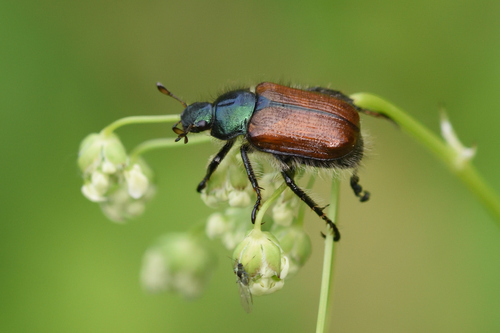
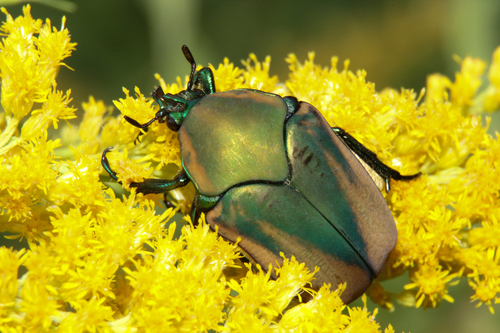
This species is scientifically known as Popillia japonica Newman, 1838. Adult Japanese beetles measure 15 mm (0.6 in) long and 10 mm (0.4 in) wide. They have iridescent copper-colored elytra, a green thorax and green head, with a row of white hair tufts (spots) extending from under the wing covers on each side of the body. Males are slightly smaller than females. Grubs of this species are white, rest in a curled position, and a mature grub is approximately 1 inch (2.5 cm) long. Popillia japonica is native to Japan, and is an invasive species in North America and Europe. The first recorded observation of this insect in the United States was in 1916 at a nursery near Riverton, New Jersey. It is thought that beetle larvae entered the United States in a shipment of iris bulbs before 1912, when commodity inspections for incoming shipments began. As of 2015, only nine western U.S. states were considered free of Japanese beetles. These beetles have been detected at West Coast U.S. airports since the 1940s. Just three specimens were found in Washington in 2020, but between late June and September 3, 2021, over 20,000 were found in Grandview, Washington alone. The first Japanese beetle recorded in Canada was accidentally brought by tourists to Yarmouth, Nova Scotia via ferry from Maine in 1939. That same year, three additional adults were captured at Yarmouth and three more at Lacolle in southern Quebec. Japanese beetles have been present on the Azores islands since the 1970s. In 2014, the first population of this species in mainland Europe was discovered near Milan, Italy. In 2017, the pest was detected in nearby Ticino, Switzerland. In 2023, the first population north of the Alps was detected in Kloten near Zürich, Switzerland. Eggs are laid individually or in small clusters near the soil surface. Ova hatch after approximately two weeks, and the newly hatched larvae feed on fine roots and other organic material. As larvae mature, they develop into C-shaped grubs that eat progressively coarser roots, and can cause economic damage to pasture and turf. Larvae hibernate inside small soil cells, and emerge in spring when soil temperatures rise again. Pupation happens 4 to 6 weeks after larvae break hibernation. Most of the beetle's life is spent in the larval stage, with only 30 to 45 days spent as a mature adult imago. Adults feed on leaf material above ground, and use pheromones to attract other beetles to form large groups that overwhelm plants, skeletonizing leaves from the top of the plant downward. Within these aggregations, beetles alternate daily between mating, feeding, and ovipositing. An adult female can lay up to 40 to 60 eggs over her lifetime. Across most of the Japanese beetle's range, its full life cycle takes one year. However, development may take two years in the extreme northern parts of its range, as well as in high-altitude zones within its native Japan.