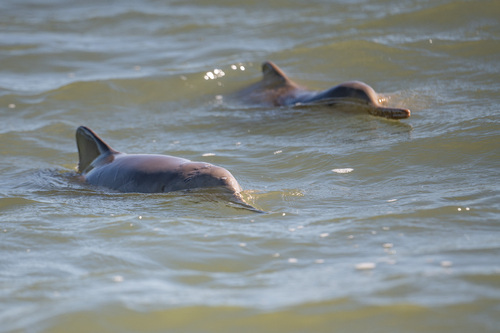
About Pontoporia blainvillei (Gervais & d'Orbigny, 1844)
Beak Proportion
Pontoporia blainvillei, known as the La Plata dolphin, has the longest beak proportionate to body size of any living cetacean, reaching up to 15% of total body length in older adults.
Size and Lifespan
Males grow to 1.6 metres (5.2 ft) in length, while females reach 1.8 metres (5.9 ft), and the species weighs up to 50 kilograms (110 lb) and lives up to 20 years.
Body Coloration
Its body is greyish brown with a lighter underside.
Flipper Structure
Flippers are large and broad relative to body size, narrow at the point where they attach to the body, giving them an almost triangular shape with serrated trailing edges.
Blowhole and Neck Feature
Its crescent-shaped blowhole sits just in front of a crease in the neck, creating the impression the dolphin’s head is permanently tilted upward.
Dorsal Fin Structure
The dorsal fin has a long base and a rounded tip.
Dentition
The species has homodont dentition of conical teeth, with 48 to 61 teeth on each side of both the upper and lower jaw.
Sexual Maturity Age
Both sexes reach sexual maturity between two and three years of age, though some populations record maturity as late as five years.
Female Reproductive Cycle
Females have a two-year reproductive cycle.
Gestation and Newborn Size
Gestation lasts 10 to 11 months, and newborn calves are 70 to 75 cm long at birth.
Weaning and First Birth
Calves are weaned at one year old, and females may give birth for the first time by age five.
Brazil Population Birth Period
Research on a population near Brazil found most births occur between September and February, during the austral spring and summer, with an average gestation period of 11 months.
Testis Size and Mating Strategy
La Plata dolphins generally have small testes, which indicates sperm competition plays a minor role in their mating strategy.
Seasonal Testis Variation
Testis size varies seasonally, matching their breeding season, but further research is needed to confirm this observation.
Mating System Inference
Relative to body mass, testis size suggests La Plata dolphins primarily practice serial monogamy, meaning individuals stay with one partner for a breeding season or part of a breeding season, rather than being strictly monogamous.
Reproductive Cycle Confirmation Need
While evidence points to a two-year reproductive cycle, more data is needed to confirm this conclusion.
General Distribution Range
The La Plata dolphin occurs in coastal Atlantic waters of southeastern South America, including the Río de la Plata estuary.
Full Distribution Limits
Its distribution ranges from the Tropic of Capricorn near Ubatuba, Brazil, south to Península Valdés, Argentina; its full reported range extends from the mouth of the Doce River in Regência, Espírito Santo, Brazil, to Península Valdés in Chubut Province, Argentina.
Habitat Salinity Adaptation
It is the only member of the river dolphin group that lives in the ocean and saltwater estuaries rather than freshwater.
Habitat Usage Variation
While some individuals spend part of their lives outside river systems, many live their entire lives within rivers and never enter the open ocean.
Group Sighting Locations
The species has been observed swimming in small groups in Miramar, Buenos Aires Province, Rio Negro Province, and Bahía Rosas.
Depth Range and Occurrence
Along the Brazilian coast, it is most commonly found in depths of 8 to 30 meters, with accidental captures recorded up to 35 meters, but a small number of individuals have been sighted further from shore.


