About Pongamia pinnata (L.) Pierre
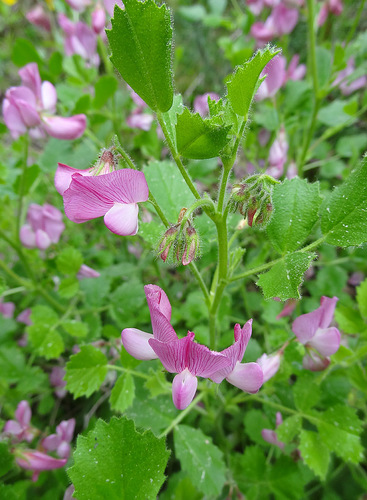
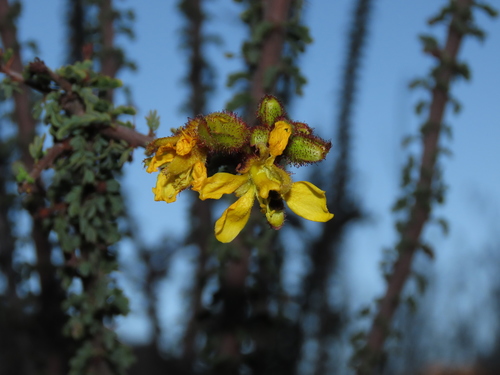
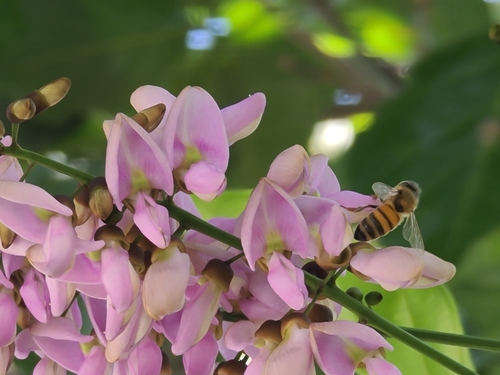
Pongamia pinnata (L.) Pierre is a legume tree that reaches 15–25 m (50–80 ft) in height, with a large canopy that spreads to the same width and produces dense shade. It may lose its leaves for short periods each year. Its trunk can be straight or crooked, with a diameter of 50–80 cm (20–30 in), and is covered in grey-brown bark that is either smooth or vertically fissured. The tree’s wood is white, and its branches are glabrous with pale stipulate scars. The alternate, short-stalked imparipinnate leaves have rounded or cuneate bases, ovate or oblong blades, and obtuse-acuminate (untoothed) tips. Young leaves are soft, shiny, and burgundy; they mature to a glossy deep green as the growing season progresses, with prominent veins on their underside. Flowering typically begins when the tree is 3–4 years old, producing small clusters of strongly fragrant white, purple, and pink flowers that can bloom year-round. The raceme-like inflorescences hold 2 to 4 flowers that grow 15–18 mm (0.59–0.71 in) long. Flower calyxes are bell-shaped and truncated, while corollas are rounded ovate with basal auricles, and often have a central green blotch. Pod production starts by 4–6 years of age, and the tree produces indehiscent pods. Brown seed pods form immediately after flowering and mature over 10 to 11 months. Pods are thick-walled, smooth, somewhat flattened, elliptical, and slightly curved, with a short curved point. Each pod contains 1 or 2 bean-like brownish-red seeds. Because pods do not split open naturally, they must decompose before seeds can germinate. Seeds are 1.5–2.5 cm (0.59–0.98 in) long, with a brittle, oily coat, and are naturally unpalatable to herbivores. Pongamia pinnata is an outbreeding diploid legume tree with a diploid chromosome number of 22. It forms determinate root nodules (similar to those of soybean and common bean), which are produced by the symbiotic bacterium Bradyrhizobium. This species is naturally distributed across tropical and temperate Asia, ranging from India to Japan, Thailand, Malesia, northern and northeastern Australia, and some Pacific islands. It has since been propagated and introduced further across the globe, growing in humid and subtropical environments from sea level up to 1,360 m (as recorded in Chingola, Zambia); in the Himalayan foothills, it does not grow above 600 m. It tolerates temperatures ranging from slightly below 0 °C (32 °F) to around 50 °C (122 °F), and annual rainfall between 500–2,500 mm (20–98 in). It grows wild on sandy and rocky soils, including oolitic limestone, can grow in most soil types, and even survives with its roots in salt water. The tree is well adapted to intense heat and full sunlight; its dense network of lateral roots and thick, long taproot give it drought tolerance. The dense shade it produces slows evaporation of surface water, and its root nodules carry out nitrogen fixation, a symbiotic process that converts gaseous atmospheric nitrogen (N₂) into ammonium (NH₄⁺), a form of nitrogen accessible to the plant. It is also a freshwater flooded forest species, able to survive continuous total submergence in water for several months, and is common in the Tonlesap lake swamp forests of Cambodia. P. pinnata is now widely distributed across India, Asia, Africa, northern Australia, the Pacific Islands, and the Caribbean Islands, and has been cultivated and transported since at least the nineteenth century. As a result, some sources note that it is naturalized in Africa and parts of the United States, while its status as native or naturalized remains uncertain in other regions. Pongamia pinnata is well adapted to arid zones, and has many traditional uses. Due to its large canopy and showy fragrant flowers, it is often used in landscaping as a windbreak or shade tree. Gardeners use its flowers as compost for other plants. Bark can be used to make twine or rope, and also yields a black gum that has historically been used to treat wounds caused by poisonous fish. While the wood is described as beautifully grained, it splits easily when sawn, so it is primarily used for firewood, posts, and tool handles. The tree’s deep taproot and drought tolerance make it ideal for controlling soil erosion and binding sand dunes. According to Rumphius, the bark of the tree (called malaparius from the Moluccan malapari) can be used to neutralize venom from eeltail catfish; peoples of Seram Timur and Banda infuse the bark with garlic, massoy, and clover to treat beri-beri. Pongamia pinnata seeds generally contain 27-39% oil, 17-37% protein, 6-7% starch, 5-7% crude fiber, 15-20% moisture, and 2-3% ash by content. Nearly half of the oil in P. pinnata seeds is oleic acid. Oil extracted from the seeds, called pongamia oil, has been used as lamp oil, in soapmaking, and as a lubricant. The oil has a high triglyceride content, and its disagreeable taste and odor come from bitter flavonoid compounds including karanjin, pongamol, tannin, and karanjachromene. These compounds cause nausea and vomiting if the natural oil is ingested. The fruits, sprouts, and seeds of P. pinnata are used in traditional medicine, and some studies have identified hiragonic acid in the species’ seed oil. It can be grown in rainwater harvesting ponds up to 6 m (20 ft) deep without losing its foliage, and remains usable for biodiesel production. Studies show P. pinnata seedlings tolerate salinity levels between 12 and 19 dS/m, and can withstand salinity stress up to 32.5 dS/m. Seed oil is suitable for use in diesel generators, and along with oils from Jatropha and castor, it has been explored as a biodiesel feedstock in hundreds of projects across India and the developing world. As a biofuel crop, P. pinnata is commercially valuable to rural populations in regions where it grows abundantly, such as India and Bangladesh, because it can support socioeconomic development of these areas. Research indicates potential use of P. pinnata as a feed source for cattle, sheep, and poultry, since its processing byproduct contains up to 30% protein. As new adaptive uses for the tree grow, it is being planted in former citrus growing regions that have declined in Florida and California due to disease and climate change.