About Pomaderris aspera Sieber ex DC.
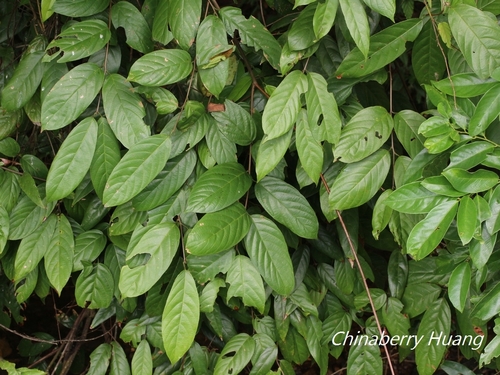
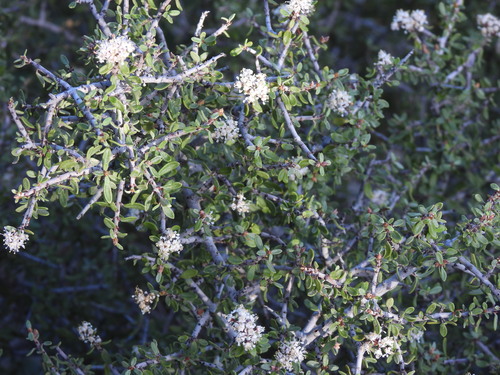
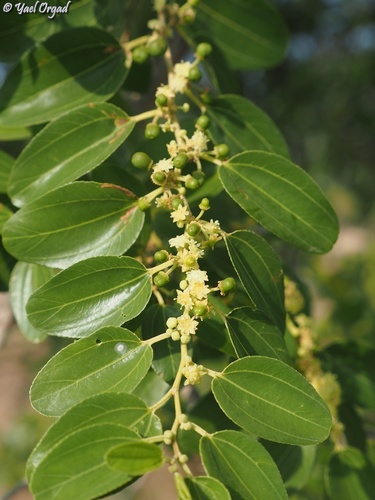
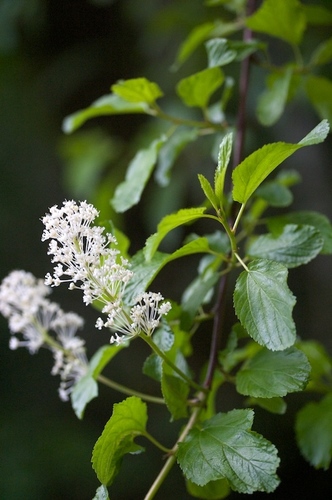
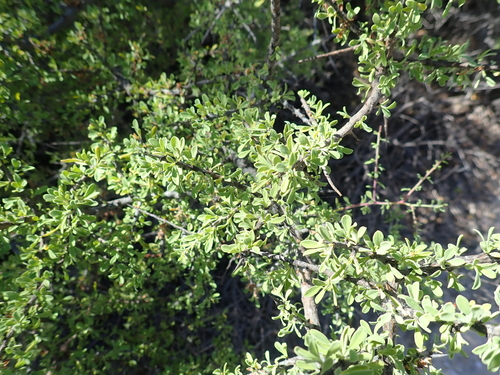
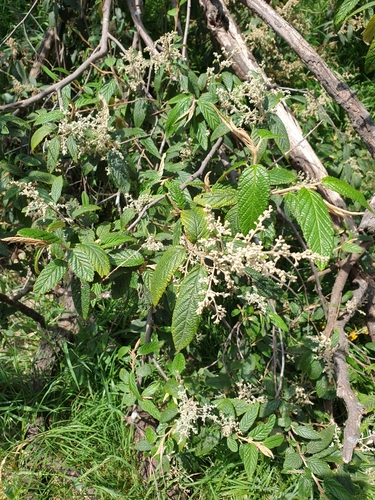
Pomaderris aspera Sieber ex DC. is a shrub or small tree that usually reaches a height of 2 to 20 meters (6 feet 7 inches to 65 feet 7 inches). It has dark brown, fairly smooth bark marked by some fissures and longitudinal irregularities. Young branchlets are covered in rust-colored, star-shaped hairs. Its leaves are elliptic to lance-shaped or egg-shaped, 40 to 120 millimeters (1.6 to 4.7 inches) long and 20 to 60 millimeters (0.79 to 2.36 inches) wide, with more or less toothed edges. The upper leaf surface is dark green, with veins that appear impressed; the lower leaf surface is whitish, with rust-colored hairs growing along the veins. Flowers grow in loose panicles 80 to 250 millimeters (3.1 to 9.8 inches) long, and are cream-colored to greenish-yellow. Each individual flower sits on a pedicel 1 to 3.5 millimeters (0.039 to 0.138 inches) long. Sepals measure 1.5 to 2.0 millimeters (0.059 to 0.079 inches) long, and this species does not produce petals. Flowering takes place in October and November. The fruit is a dark brown, hairless capsule 3 millimeters (0.12 inches) in diameter that holds one bone-colored seed. Pomaderris aspera grows in wet forest, particularly near streams in gullies. It mainly occurs south of Barrington Tops in New South Wales and the Australian Capital Territory, with scattered populations in northern New South Wales extending as far north as Bunya Mountains National Park in Queensland. It is common in southern and eastern Victoria, less common in northern Tasmania, and may also be found in South Australia. This species has also become naturalised in New Zealand.