About Pomacentrus moluccensis Bleeker, 1853
Taxonomic Naming
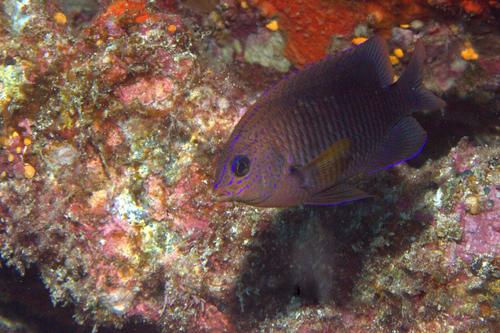
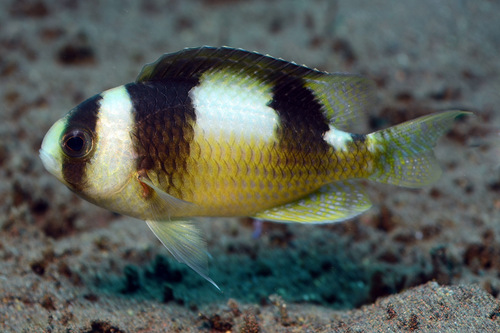
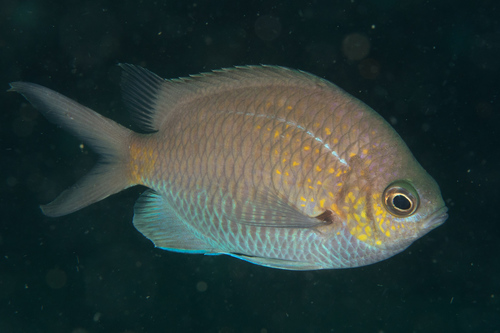
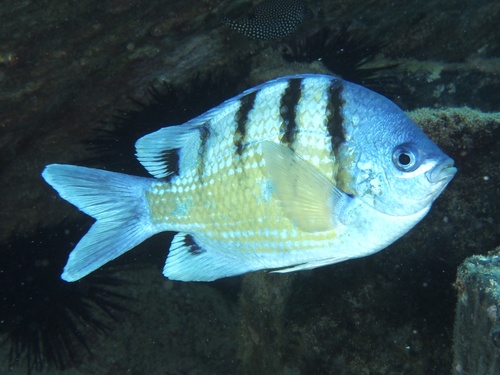
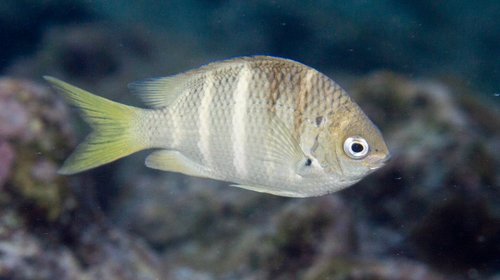
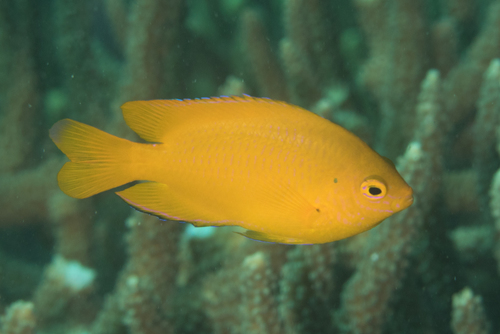
Pomacentrus moluccensis Bleeker, 1853 is a deep-bodied, laterally compressed fish that reaches an approximate maximum length of 9 cm, or 4 inches.
Head Morphology
Its head is slightly longer than it is tall, featuring a large eye and an oblique mouth.
Dentition
Its teeth are arranged in two series and end in rounded tips.
Dorsal Fin Structure
The dorsal fin has 13 spines and 13 to 14 soft rays.
Anal Fin Structure
The anal fin has 2 spines and 14 soft rays; the first anal spine measures half the size of the second.
Pelvic Fin Structure
The first ray of the pelvic fins is far longer than the fish's head, and significantly elongated.
Pectoral & Caudal Fin Structure
The pectoral fins are comparatively shorter, and the caudal fin is shallowly forked with rounded lobes.
Coloration
The body of this fish is uniformly yellow, with a small orange spot at the base of the pectoral fin, which is absent on individuals found in the Philippines.
Geographic Range
This species is native to the tropical western Pacific Ocean, with a range spanning from roughly 32°N to 32°S latitude, and 92°E to 173°W longitude.
Depth Habitat
It inhabits depths down to approximately 14 m, or 46 ft, in clear-water lagoons and reefs where branching corals offer hiding places.
Social Grouping
Pomacentrus moluccensis lives in small groups on and around coral reefs.
Diet
Its diet is made up mostly of algae, though it also consumes planktonic invertebrates.
Breeding Behavior
During breeding season, this fish forms pairs; females lay their eggs on the substrate, while males guard the eggs and fan them to maintain sufficient aeration.
Known Predators
It is preyed on by predatory fish species including Cephalopholis boenak and Pseudochromis fuscus.
Predator Evasion
It survives and evades predators more successfully in high-shelter environments like those provided by Pocillopora damicornis, compared to low-shelter environments such as those provided by Acropora nobilis.
Bleaching Response
As a coral-associated species, Pomacentrus moluccensis has been recorded to decline dramatically after coral bleaching events.