About Polyura delphis (Doubleday, 1843)
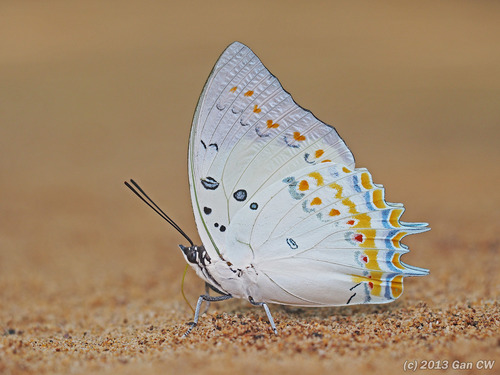
Polyura delphis (Doubleday, 1843), originally documented as E. delphis, is a predominantly Macromalayan species that ranges north as far as Assam. Below is a technical description and variation of its recognized subspecies. delphis delphis (Dbl., the name-type) originates from Silhet. Males are very similar to P. delphis concha, but as a rule, their subapical spot is more distinctly pronounced, and the black apical margin of the forewings is more distinctly dentate proximally and decidedly narrower than in concha. The under surface can only be distinguished from that of delphis delphinion by its somewhat finer blue discal lunular spots. A female from Tenasserim differs from the male only by the more prominent light ochre-yellow submarginal band on the under surface of the hindwings. This subspecies appears to fly year-round, though individual butterflies are always rare. Specimens collected near Bangkok in the dry season are smaller than those from Tenasserim, and have a darker greenish lustre on the upper side. Pavie also observed delphis near Bangkok. concha Voll. has been examined in large numbers from West Sumatra, from the area around Padang Pandjang. This subspecies is considerably larger than all other vicarious types of the species. The apical macula of the forewings is either very small or absent. The posterior submarginal lunae on the upper surface of the hindwings are inconspicuously filled with white. The anterior tail is longer than in nominate delphis. The female remains undescribed; males are never common, and prefer wet spots on woodland paths and river crossings, often found in the middle of swarms of Pierides and Papilio antiphates. othonis Fruhst. resembles concha on the upper surface, but is smaller, with a somewhat narrower black apical margin. Its under surface is characterized by a very broad greenish-ochreous submarginal band that extends distally all the way to the slender light blue anteterminal streaks, making the band even broader than that of the female nominate delphis from Tenasserim described above. A female held in the Adams Collection at the British Museum is larger than the male, and the characteristic yellow band of othonis is twice as broad in the female as it is in the male. This subspecies is found on the Island of Nias, and is very rare. cygnus R. and J. is a distinct subspecies most closely allied to Assam populations of nominate delphis in general form, and shares the mostly large apical spot on the male forewings. It is distinguished on the under surface by smaller blue circles and indistinct bands on the hindwings that are more greenish than ochreous. It occurs in East and West Java, and is very rare. Only two female specimens are known: one examined by the author from the promontory of the Tengger Mountains in East Java, and another collected by the author held in the Adams Collection from East Java. Females are about one third larger than males, and have somewhat more distinct yellowish-green bands on the under surface of the hindwings. delphinion Fruhst. is smaller and more intensely yellow than concha, with more blurred black and green submarginal lunae on the upper surface of the hindwings. It has shorter tails, and the yellow bands on the under surface are darker. It occurs in North and South Borneo. niveus R. and J. has an even more reduced black apical margin than delphinion, and has narrower but darker ochreous longitudinal bands on the under surface of the hindwings. It is very rare, and found on the Island of Palawan.