About Polytela gloriosae Fabricius, 1781
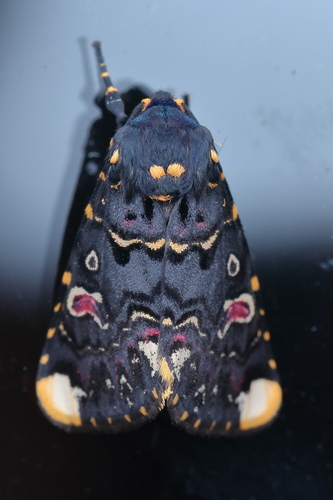
For adult male Polytela gloriosae, wingspan measures 29 mm. Adults have hairy eyes, a fully developed proboscis, and porrect (forward-extending) palpi covered in rough scales. The head and thorax are blue-black, and antennae are orange. Three orange specks appear on the metathorax. The abdomen is blackish, with orange terminal segments. Forewings are blue-black, with one orange speck at the base, two pink and black lunules that run toward the inner margin, a yellow orbicular marking with a ring, a yellowish reniform marking, and large orange blotches at the apex and outer angle. Hindwings are fuscous. The species' caterpillars are smooth and purple-black, with series of white spots on the dorsal, lateral, and sublateral body areas, and purplish lateral blotches on the thoracic somites. Caterpillar heads and legs are reddish; early instars are more reddish-brown, and the body darkens as caterpillars reach later instars. Eggs are small, spherical, and yellow. In the species' life cycle, females lay 80 to 90 eggs in 2 to 4 clusters. Eggs turn black after 3 days and hatch within 4 days. The larval stage includes five instars, and takes 8 to 10 days to complete. The first instar is 3–10 mm long, with a black head and light brown body. First instars are gregarious, and feeding begins six hours after hatching; this stage lasts 1–1.5 days. The second instar is 1–2 cm long, with a black head and light brown body with white spots; this stage lasts 1.5 days. The third instar is 2–3 cm long, with a black head, and a body with 5 rows of black spots and 6 orange spots. Third instars feed voraciously on leaves, and this stage lasts 2 days. The fourth instar is 3–3.8 cm long, with a black head, and a body with 5 rows of white spots on the back and 6 orange spots at the anterior and posterior ends. Fourth instars feed on plant tissues, and this stage lasts 2 days. The fifth instar is 3.5–4 cm long, with a black head, and a body with 5 rows of white spots and 6 orange spots at the anterior and posterior ends. Fifth instars feed on plant tissues, and can completely destroy host plants; this stage lasts 2.5 days. Pupae are obtect, with a broader anterior side. Early-stage pupae are light-colored, and darken to dark brownish or blackish near emergence. Pupation takes place inside an earthen cell in soil, and the pupal stage lasts 7.5 days.