About Polystictus pectoralis (Vieillot, 1817)
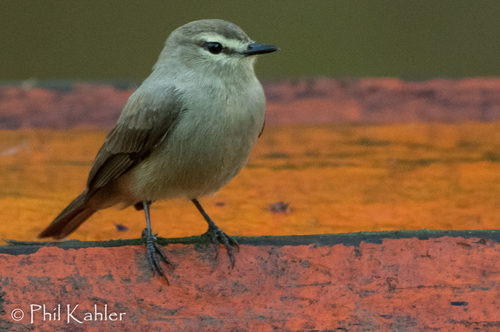
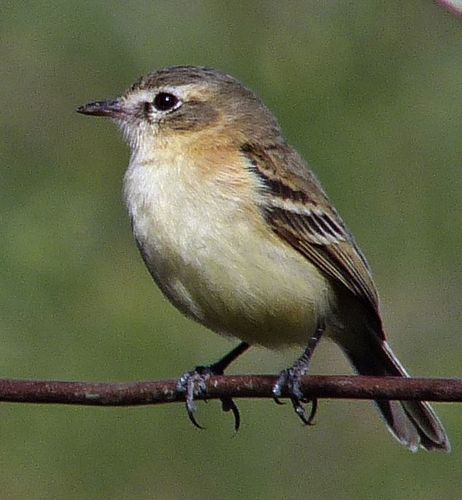
The bearded tachuri, with the scientific name Polystictus pectoralis (Vieillot, 1817), measures 8 to 10.5 cm (3.1 to 4.1 in) long and weighs 6 to 8 grams (0.21 to 0.28 oz). For the nominate subspecies, adult males have a dusky gray to blackish crown with a bushy but usually flattened crest; the white center of the crown is mostly hidden. They have a short white supercilium and a thin blackish line running through the eye, and the rest of their face is thinly striped with black and white. Their upperparts are mostly buffy brown, with a tawny to rufous rump. Their wings are dusky, with bright cinnamon-buff edges on the flight feathers and bright cinnamon-buff tips on the wing coverts; these tips form two distinct wing bars. Their tail is dusky. Their chin, called the "beard", has thin black and white stripes. Their throat and underparts are pale yellowish white, with a cinnamon wash on the breast and flanks. Adult females are overall duller than males, and they do not have the male's "beard". Their crown and face are mostly brown, and their throat is whitish. Juveniles have reddish edges on their flight feathers, buffy wing bars, and deeper yellow underparts than adult bearded tachuri. Subspecies P. p. brevipennis is significantly smaller than the nominate subspecies, has a smaller crest, and males have less black on the face and throat. Subspecies P. p. bogotensis is quite different from the other two subspecies: compared to the other two, it has a thinner and longer crest, less white on the crown, a bright buff supercilium, an ochraceous tawny face, a more tawny back, deeper tawny edges on its flight feathers and wing coverts, a nearly all white throat, and deeper, richer tawny flanks. For both sexes of all subspecies, the iris is fuscous brown, the bill is black, and the legs and feet are black. The bearded tachuri has a highly disjunct distribution. The nominate subspecies has the largest range, and is found in eastern Bolivia, most of Paraguay, western Uruguay, northern Argentina south to the provinces of Mendoza, La Pampa and Buenos Aires, and southern Brazil in an area roughly bounded by Mato Grosso, southern Minas Gerais, and Mato Grosso do Sul. Subspecies P. p. brevipennis is found from eastern Colombia into western Venezuela, across several areas in central and southeastern Venezuela, and separately in each of the Guianas and portions of northern Brazil. P. p. bogotensis is (or was) found only in very localized areas in Colombia's Cundinamarca and Valle del Cauca departments. The bearded tachuri is primarily a grassland species. It occurs in savanna with scattered shrubs and scrub, tall grassy areas in cerrado, Venezuela's Gran Sabana, and campos rupestres in Brazil. Most populations occur below 1,300 m (4,300 ft) in elevation, but P. p. bogotensis can be found up to 2,600 m (8,500 ft).