About Polysticta stelleri (Pallas, 1769)
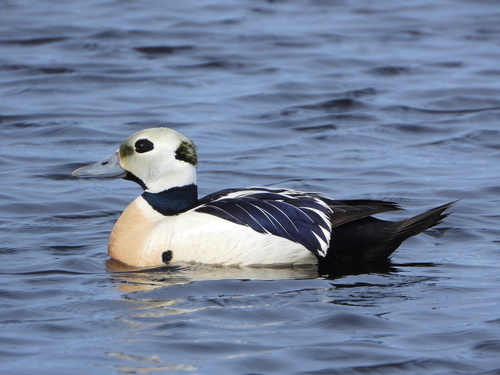
Steller's eider, whose scientific name is Polysticta stelleri (Pallas, 1769), is the smallest of the four known eider species. Both females and males have an average weight of 860 g (30 oz). They have a compact body, a relatively large head with a flat crown and an angled nape, and a long, thick bill. Their tail is longer relative to their body than that of other eiders. Breeding males hold their breeding plumage from early winter to midsummer: they have a black cap, chin, collar, eye-ring, and rump, a white head and shoulders, light green patches behind the head and in front of the eye, and a cinnamon breast and shoulders marked with a prominent black spot. Their long tertial feathers drape over the folded wing; these feathers are dark purple-black, with a white stripe along each. From mid-summer to autumn, males molt into eclipse (non-breeding) plumage, which is primarily dark brown like female plumage, but males keep the white inner forewing that is easily visible when they fly. Both sexes have an iridescent bluish-purple speculum on their wing's secondary feathers, with white borders running the full length of the secondaries. Females are colored dark to cinnamon brown, with a pale-white eye-ring. Juveniles look similar to females, but are lighter brown, have only narrow white edges to the speculum, and have shorter tertial feathers. Steller's eiders have palmate feet with three fully webbed toes; their feet and legs are both dark bluish-grey. In winter, Steller's eiders live in coastal bays and lagoons that provide suitable forage, and they occasionally feed in deeper, adequately sheltered waters. They nest in coastal marshy tundra, in areas dominated by water sedge and pendant grass. Within this tundra habitat, they choose specific elevated surfaces covered by shallow vegetation like mosses and grasses to build their nests. Their moulting habitat is made up of relatively shallow coastal lagoons that provide viable eelgrass and tidal flats for foraging, plus beaches and sandbars for resting while they are flightless. In 2001, the United States Fish and Wildlife Service designated five critical breeding habitats on the Yukon–Kuskokwim Delta, and four marine water units along the coast of southwest Alaska that are critical for moulting, feeding, and wintering. The entire designated critical habitat covers approximately 7,300 square kilometres (2,800 sq mi) and includes 1,370 kilometres (850 mi) of coastline. Ringing studies show that Steller's eiders reach sexual maturity at two years old, and can live up to 21 years and 4 months. Males form leks on both wintering and breeding grounds: groups of males perform elaborate displays to court a single female. Males court females in silence, displaying a consistent sequence of side-to-side head-shaking while swimming toward and away from their potential partner. Unlike most waterfowl, which form breeding pairs in fall, Steller's eiders form breeding pairs from late winter to early spring. Breeding pairs can arrive at their nesting sites as early as the beginning of June. Females build their nests in marshy tundra near permanent open water, with additional access to small ponds. They specifically choose mounds or ridges dominated by mosses, lichens, and grasses. The nest is a shallow scrape, lined with grasses, moss, lichens, and down feathers plucked from the female's breast. The female builds the nest with no assistance from the male. Females usually lay 1 to 8 olive to brownish-orange eggs per breeding cycle. The female alone incubates the eggs for around 25 days. The young are precocial: they hatch between late June and late July, with their eyes open and covered in downy feathers. Predators often eat most eggs before they can hatch. Soon after hatching, the young move to the water and begin feeding themselves immediately, with no reliance on their mother for food. Despite this feeding independence, females stay within 700 m of their nest for up to 35 days after hatching. Young begin flying approximately 40 days after hatching. It is common for a single female to take over care of two or more sets of young from other females. High lead levels have been recorded in Steller's eiders that nest on Alaska's Arctic Coastal plain, as well as in Spectacled Eiders that occupy the Yukon–Kuskokwim Delta, where Steller's Eiders still nest at greatly reduced population densities. Additional studies have also found that lead concentration is higher in Steller's eiders living close to industrialised regions than in those living in non-industrialised regions.