About Polyspora axillaris (Roxb. ex Ker Gawl.) Sweet
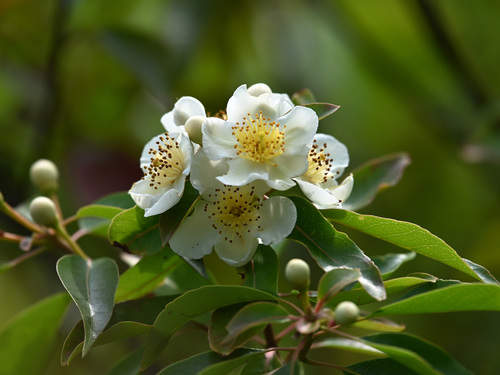
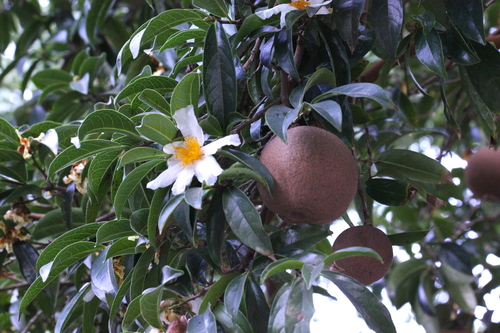
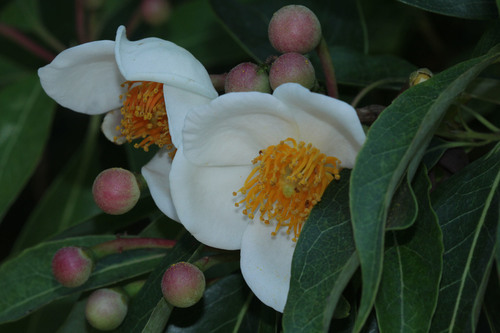
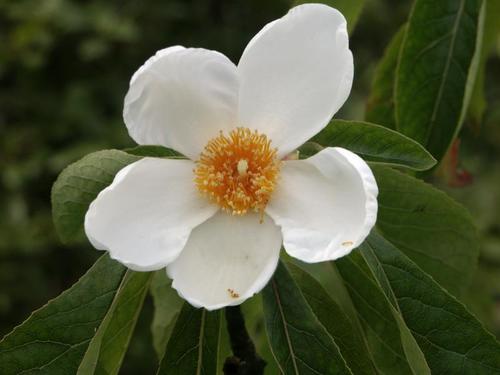
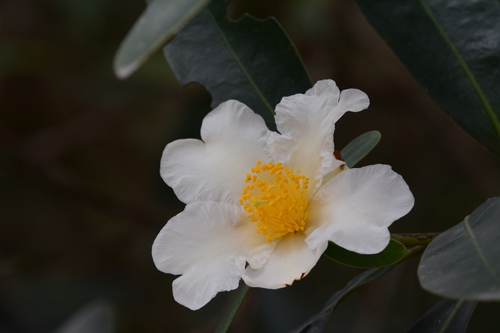
Polyspora axillaris is an evergreen tree that can grow up to 8 meters tall. It has smooth orange-brown bark, and its stout branchlets are densely covered in fine hairs. Its leaf blades are leathery, dull and hairless on the upper surface, and pale green with a prominent midvein on the lower surface. Leaf blades range in shape from oblong-ovate to oblanceolate, with rounded or blunt tips and a cuneate, slightly decurrent base. Leaf margins are usually entire, and occasionally develop slight crenations near the apex; the leaf's lateral veins are indistinct. The flowers of this species are large, and grow singly or in pairs. They have five white petals and numerous yellow stamens. The fruit is an oblong to oblong-ovoid capsule that holds compressed, winged seeds. This species is distributed in southern China (including Hainan, Hong Kong, Guangxi, and Guangdong), as well as Taiwan and Vietnam. It grows at elevations between roughly 100 and 2,300 meters above sea level, found on hillsides where it is adapted to anchor to slopes during exposure to rain and storms. While it is abundant in Hong Kong, earlier studies have observed that this wind-dispersed tree has a strongly clustered distribution pattern, caused by its relatively heavy seeds. It can become a dominant species in shrublands and early-successional secondary forests, but does not dominate in lowland areas. In terms of ecology, the fragrant flowers attract pollinators like bees and butterflies. Some flowers develop in leaf axils, a trait reflected in the species epithet axillaris. Flowers detach from the tree before they start wilting. While high aluminum ion concentrations are toxic to most plants, this species can tolerate high aluminum ion levels by accumulating the ions in its leaves and roots through a reaction with fluoride ions.