About Polyphylla decemlineata (Say, 1824)
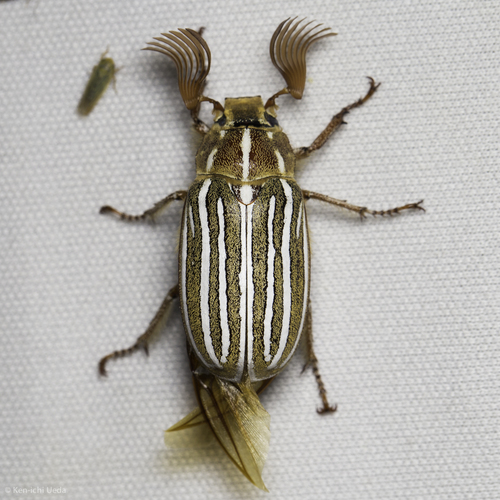
Polyphylla decemlineata (Say, 1824), commonly called the ten-lined June beetle, is a relatively large species; adults can reach 1.5 inches (3 cm) or more in size. Like other species in the Polyphylla genus, males have large, distinctive antennae made of several lamellate plates, which they close up when threatened. Males use these antennae to detect pheromones released by females. Each of the species’ hard wing covers, called elytra, has four long white stripes and one short stripe. When the elytra are closed, the short stripe appears to match the other eight total stripes across both wing covers; when the elytra open, this short stripe is revealed to be two small separate lines rather than one larger line. The underside of the beetle’s thorax is covered in brownish hairs. Adult ten-lined June beetles are normally active from early dusk until around midnight, and they are commonly attracted to lights. This attraction to lights is linked to their poor eyesight, and it is dangerous for the beetles: lights make them easier for predators to spot, and they often fall into human-laid traps such as blacklight traps. This species lives in forests, shrublands, and farmlands. Denser populations are most often found in U.S. states with large agricultural industries, such as Washington and California. Ten-lined June beetles thrive in sandy soils west of the Rocky Mountains. While sometimes reported across the entire United States, their established range is restricted to the Northern and Western United States and Canada. Multiple predators and parasites target this beetle. Birds commonly eat ten-lined June beetle larvae, while owls and bats consume adult beetles. Tachinid flies commonly parasitize adult ten-lined June beetles, but this parasitism does not pose a major threat to the species compared to larger predators. Tiphiid wasps parasitize the beetle’s larvae, and these wasps are a much larger threat than tachinid flies. In response to threats, adult ten-lined June beetles have a hissing mechanism that mimics bat sounds to deter predators. It is not recommended that humans eat these beetles, as eating too many can cause gastrointestinal problems including, but not limited to, diarrhea. This species is often confused with Polyphylla crinita, the long-haired June beetle. Ten-lined June beetles have scales on their pronotum, while long-haired June beetles have setae (hairs) on their pronotum. High-resolution photos are required to reliably tell the two species apart. The ten-lined June beetle has a multi-stage life cycle. Females lay oval, dull creamy white eggs that measure about 1/16 of an inch long. Females lay eggs deep in soil to reduce predation, though other insects still eat some eggs. The grub (larval stage) can grow up to 2 inches (5 cm) long, has a white body, brown head, and three pairs of legs. The larval stage can last up to four years, but most often lasts between two and three years. Larvae go through three instars before moving to the pupal stage the following spring. Larvae live underground between roughly 0.1 and 0.35 meters deep; younger larvae stay closer to the soil surface, while older larvae live deeper underground. Their underground habitat makes most control measures against them ineffective. Pupae are creamy white, measure between 1 and 1.5 inches long, and have external wing pads that develop into elytra when the beetle matures. Adult beetles begin emerging from the ground in early summer (June) and continue emerging through July. Once mature, female ten-lined June beetles release pheromones to attract mates. After mating, females return to the soil to lay their eggs, while males leave to seek other mates. Adult ten-lined June beetles live only about 10 months after reaching maturity, which is unusually long for adults of this beetle genus.