About Polyommatus icarus (von Rottemburg, 1775)
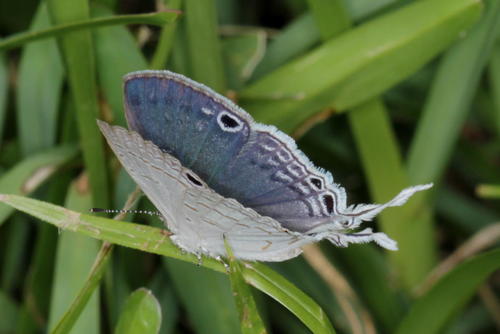
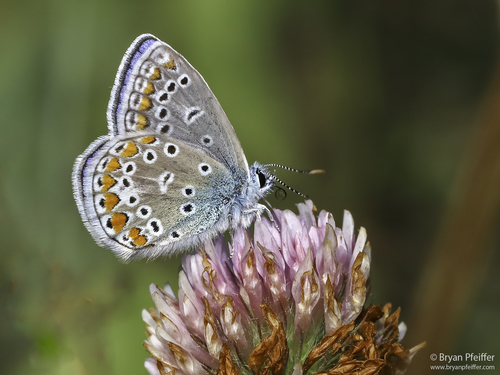
Common blue butterfly, with the scientific name Polyommatus icarus (von Rottemburg, 1775), has a wingspan of 28 to 36 millimetres (1.1–1.4 in). The dorsal side of its wings is iridescent lilac blue, bright violet-blue, or almost hyacinth-blue, with a thin black border. Female common blues have brown or black-brown wings, with a row of reddish yellow marginal spots along the wing edges, and usually have some blue colouring at the base of the wings. The proportion of blue and brown on female wings varies extremely depending on location; females may have mostly blue on the top of their wings, especially in Ireland and Scotland, but they always have red spots. On the ventral side of the wings, males have a greyish or dust-grey base colour, while females have a more brownish hue. Both sexes have a row of red or orange spots along the edge of the hindwing that extend onto the forewing, though these spots are generally fainter on the forewing. This is particularly the case in males, where the spots are sometimes missing entirely. There are around a dozen black-centered white spots, called ocelli, on the hindwing, and nine on the forewing. These spots usually include one in the middle of the forewing cell, which is absent in Chapman's blues and Escher's blues. The fringes on the outer edge of the wings are uniform white, and are not crossed with black lines like the fringes of chalkhill blues and Adonis blues; this means the common blue does not have checkered fringes. Other species similar to Polyommatus icarus are Polyommatus semiargus, Polyommatus coridon, Polyommatus dorylas, Polyommatus amandus, Polyommatus damon, and Polyommatus celina. The caterpillar of the common blue is small, pale green with yellow stripes, and is rather slug-like, which is typical for Lycaenid larvae. The common blue butterfly is found in Europe, North Africa, the Canary Islands, and east across the Palearctic to Northern China. It was recently discovered in Quebec, Canada, and is widespread across the British Isles. Its overall distribution has declined by 15% since the 1970s. These butterflies live in flowery or grassy places, in both warm and cool conditions, and in both open and wooded areas. They can be found at all altitudes up to high alpine meadows, from 0 to 2,700 m (0–9,000 ft) above sea level. They mostly live on chalk or limestone grassland, but also occur in smaller numbers in woodland clearings, meadows, heathlands, sand dunes, along railway embankments, and under cliffs. In its caterpillar stage, the common blue eats leaves. As an adult butterfly, it feeds on wildflower nectar and excrement. Adult common blues live for 3 weeks. Males are often very noticeable, as they defend territories against rival males and search for the more reclusive females. In the south of Britain, there are two broods per year, with adults flying in May and June, and again in August and September. In northern England, there is one brood per year, with adults flying between June and September. In years with a long warm season, a partial third brood sometimes occurs in southern Britain, with adults flying into October. The larvae feed on plants from the bean family, Leguminosae. Recorded larval food plants include Lathyrus species, Vicia species, Vicia cracca, Oxytropis campestris, bird's foot trefoil (Lotus corniculatus), Oxytropis pyrenaica, Astragalus aristatus, Astragalus onobrychis, Astragalus pinetorum, black medick (Medicago lupulina), Medicago romanica, Medicago falcata, common restharrow (Ononis repens), wild thyme Thymus serpyllum, lesser trefoil (Trifolium dubium), Trifolium pratense, and white clover (Trifolium repens).