About Polyommatus eros (Ochsenheimer, 1808)
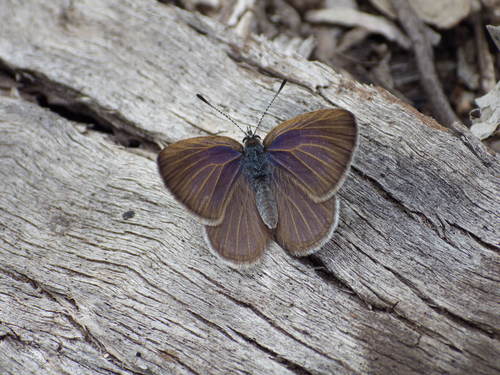
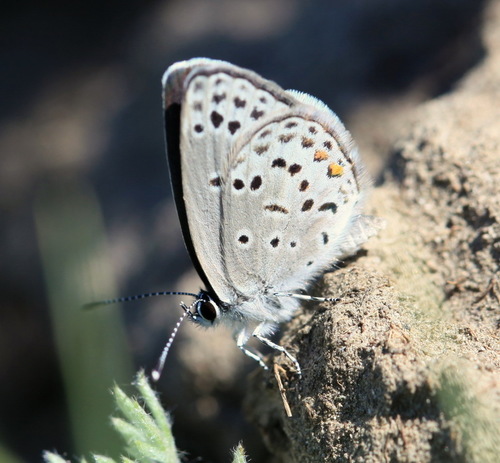
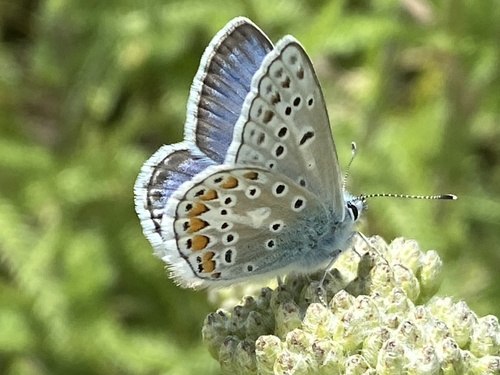
Polyommatus eros (Ochsenheimer, 1808), originally described in Seitz, has the following characteristics. Males are very bright blue with an enamel-like metallic gloss; forewings have a black margin, and hindwings have black distal-marginal spots that strongly contrast with the insect's pure white fringes. Females are brown, and sometimes have yellowish red distal-marginal spots. The underside strongly resembles that of Polyommatus icarus, but both males and females have a distinct white median streak on the hindwing. The species is found in the higher mountains of southern Europe as far as the Alps, and in the mountain districts of Anterior Asia. Several aberrations are noted: ab. petrividorda Favre lacks black marginal spots on the underside of the hindwing, and has a white band before the margin instead; ab. albipicta Schultz has a white discocellular spot on the upperside of the forewing, rather than the barely visible black spot; ab. caerulescens Oberth. are females with bright blue uppersides, which occur as rare singletons in Europe, and have been reported as a constant form in West China, though this is considered very improbable, as Leech did not document the form. Several subspecies and formerly included forms are also described. P. e. erotides Staudinger, 1892 from the mountains of Southern Siberia is a large male form, blue-green in color, with a broad black distal margin to the forewing that deep black veins merge into. P. e. eroides (Frivaldszky, 1835) is more sky-blue than greenish blue, and is the largest form of the species after the next described form; it occurs in Eastern Europe, particularly Russia and the Balkan Peninsula, extending west into Germany where it is rare, found only in East Prussia and Posen. Males of the South Russian subspecies P. e. boisduvalii (Herrich-Schäffer, [1843]) have a distinct blue shade: it is paler, purer, and brighter than other forms; the forewing has a broad black outer margin, with thin but sharply marked black veins in the forewing's apical area. Polyommatus sutleja (Moore, 1882), from Kashmir, was previously treated as a subspecies of P. eros; it is extremely close to boisduvalii, sharing the same blue tint, but has a somewhat narrower black margin, and black veins in the apical area of the forewing that are not quite as sharply defined. Polyommatus amor (Lang, 1884), from Ferghana and the Tian-shan, was previously included in P. eros; the blue of the male's upperside has a violet sheen, nearly matching that of P. icarus, and has a narrower black margin. P. e. napaea (Grum-Grshimailo, 1891) shares the same blue upperside tint as P. icarus, but has a much broader black margin, and also a broader costal area on the hindwing; it is found in the Boro-Choro Mts. in Central Asia. Polyommatus erigone (Grum-Grshimailo, 1890), from the Pamir, previously treated as a P. eros subspecies, is considerably smaller; ocelli are less prominent on the underside, and the white streak of the hindwing is very distinct. Females also bear a superficial resemblance to P. icarus, and the blue color of high-altitude (13,000 ft.) male erigone is almost exactly the same as that of P. icarus. Polyommatus pseuderos Moore, 1879, previously included in P. eros, ranges further south to Kashmir; it has black-grey distal-marginal spots on the upperside, lacks basal ocelli on the underside of the forewing, and has a straighter discal row of ocelli. helena Gr.-Grsh., now treated as P. e. amdoensis (Wnukowsky, 1929) from the Sinin Mts., resembles East Russian eroides, but its blue already has a slight violet tinge, and has a narrower black margin. On the underside, the rust-yellow submarginal spots are larger, and the dark marginal spots are deeper black and more prominent. It is possible that Polyommatus bilucha (Moore, 1884), from Quetta outside Palearctic territory, also belongs to this group. The early life stages of the species are not currently known. Butterflies fly from June to August, they are not rare, and are among the most frequent visitors to damp roadside areas in the Alps. Their habits and flight match most closely with those of argus and argyrognomon. There are two distinct taxonomic perspectives on the range and subspecies of P. eros. In one view, the distribution is restricted to the Alps, Pyrenees, Apennines, Balkan Mountains, and mountainous regions of Turkey, with only a small number of subspecies, and all East Palearctic forms are treated as full separate species. In the other view, P. eros has a large number of subspecies that extend across the Himalayas and Central Asian highlands. P. eros is predominantly found at high altitudes above 1800 meters, and its preferred habitat is flowering grassy mountain slopes. The Polyommatus eros-eroides complex is made up of mostly allopatric populations with unclear relationships. Most authors consider P. menelaos Brown, 1996 from Peloponnese to be closely related to P. eros rather than to P. eroides, which occurs in mainland Greece. The status of P. eroides and P. eros as distinct species is only supported by very slight differences in coloration and habitat, with P. eros mainly inhabiting higher altitudes above 1800 m. Recognized subspecies of P. eros sensu lato include: P. e. eros; P. e. eroides (Frivaldszky, 1835), found in the Balkans and Asia Minor; P. e. boisduvalii (Herrich-Schäffer, [1843]), found in East Germany, Czech Republic, Poland, Southeast Europe, Southwest Siberia, and North Kazakhstan to Altai; P. e. napaea (Grum-Grshimailo, 1891), found in Tian-Shan, Ghissar, and Alai; P. e. erotides Staudinger, 1892, found in Saur, Altai, mountainous South Siberia, Transbaikalia, and Mongolia; P. e. amdoensis (Wnukowsky, 1929); P. e. kamtshadalis (Sheljuzhko, 1933), found from the Polar Urals to the Far East and Amur; P. e. gansuensis Murayama, 1983; P. e. extremiorientalis (Kurentzov, 1970), found in Verkhoyan'ye and Kolyma; P. e. menelaos Brown, 1976, found in Greece; P. e. yildizae Koçak, 1977, found in Northeast Turkey; P. e. tshetverikovi Nekrutenko, 1977, found in Caucasus Major; P. e. taimyrensis Korshunov, 1982, found on Taymyr Peninsula and the Polar Ural; P. e. erotulus Nekrutenko, 1985, found in Azerbaijan and Iran; P. e. aloisi Bálint, 1987, found in South Mongolia; P. e. molleti Carbonell, [1994], found in Turkey; P. e. meoticus Zhdanko & Stshurov, 1998, found in Northwest Caucasus; P. e. kaabaki Korb, 2000; P. e. krulikowskyi (Gorbunov, 2001); P. e. divisus Churkin, 2003, found in Mongolia; P. e. pacificus Stradomsky & Tuzov, 2006, found in Primorye; and P. e. silvester Korb & Bolshakov, 2011, found in Poland, Byelorussia, and Ukraine.