About Polyommatus daphnis (Denis & Schiffermüller), 1776
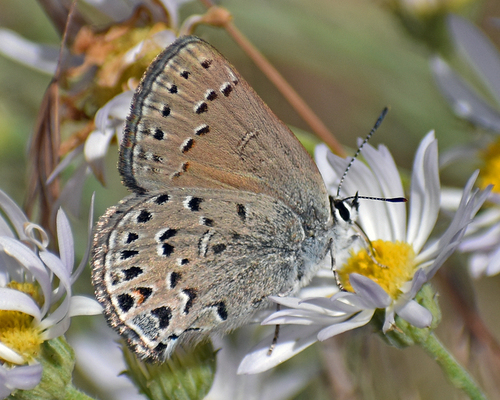
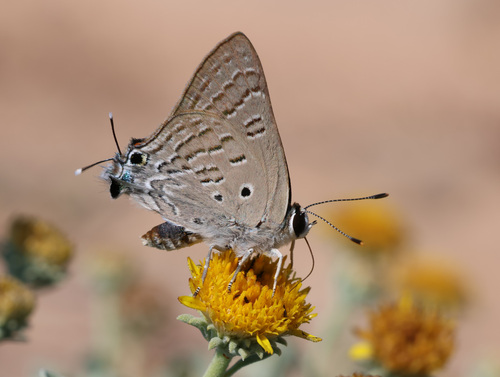
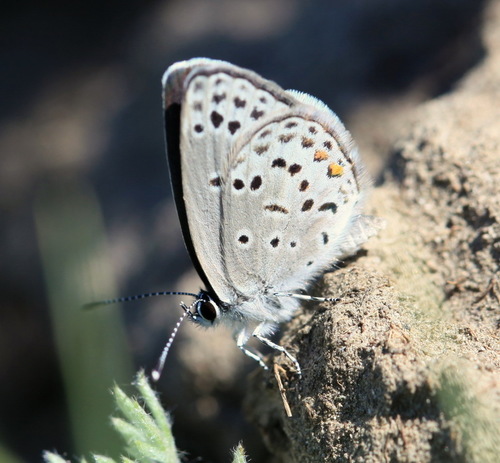
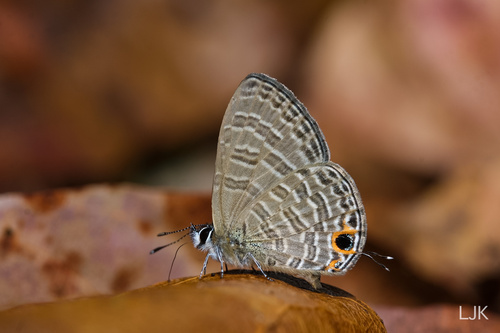
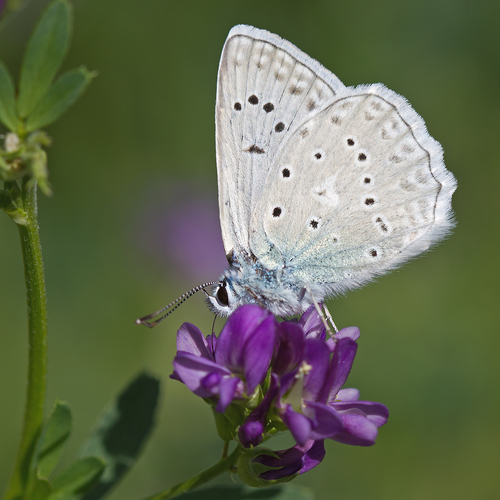
This butterfly species, Polyommatus daphnis (Denis & Schiffermüller), 1776, has a wingspan of 36–38 millimetres (1.4–1.5 in), and the species displays distinct sexual dimorphism. On the upper side of the wings, males are bright blue, while females are typically blue with a dark brown border. The underside of the wings is pale ocher in females and grey-bluish in males, with black spots each surrounded by white. The hindwings are distinctly scalloped, particularly in females.
In Seitz's description, this species is also referenced as L. meleager Esp. (= daphnis Bgstr., female = endymion Schiff.) (81 a). Males are very large, very light sky-blue with strong gloss and a very narrow black margin. The underside is pale grey-brown, with a blue-dusted base, and the oceli are not very prominent, with those near the hindwing margin being very weak. Females are immediately recognizable by the dentate anal portion of the outer margin. The species' range in this account extends from Central and South Germany, Switzerland and South France throughout South-East Europe and Asia Minor to Syria and Kurdistan. Aberration limbopunctata Schulz consists of males that have black marginal spots on the wing upperside. Aberration steeveni Trk. (81 a) refers to strongly darkened females; this form has a very wide distribution among typical specimens, but is more common in the East, including Greece and Asia Minor. The versicolor Ruhl-Heyne form comes from Mesopotamia, it has very light blue upperside wings and completely lacks marginal spots on the underside. ignorata Stgr. [= P. d. versicolor (Rühl, 1895)] (81 a), found in Akbes in the south-western Taurus, has unusual colouration: the upperside of the female is crossed by many shadowy streaks along the veins; the male's hindwing is also dentate in the anal portion, while in the female the teeth are so prominent that they form 2–3 short tails. The larva is green with yellow swellings and black spiracles. It feeds on Thymus, Orobus, Astragalus, and Coronilla until June. Adult butterflies fly in July and August. They prefer limestone soil, occur singly in hot valleys, and are found more often in hills and plains than in mountains, resting on meadow flowers singly. This species is distributed in Eastern and Southern Europe and Western Asia, with a range extending from Southern Poland to the Balkans, Lebanon, Syria, Iran, Southern Urals, Turkey, Caucasus and Transcaucasia. Its habitat includes grassy and bushy areas, scrubland clearings, and open flowery meadows in hills, at elevations between 200–1,700 metres (660–5,580 ft) above sea level.