About Polygonum ramosissimum Michx.
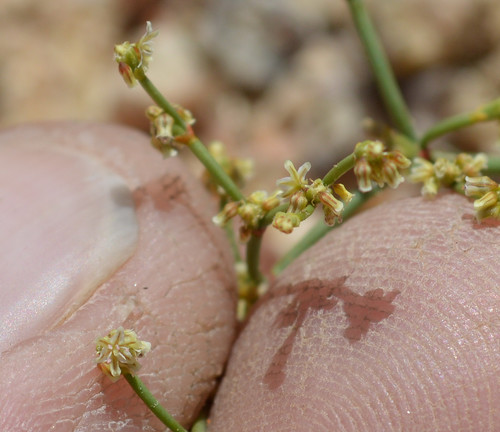
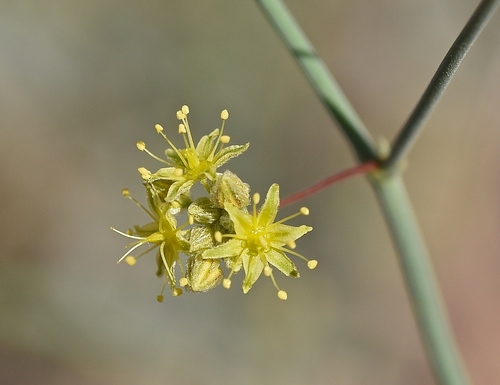
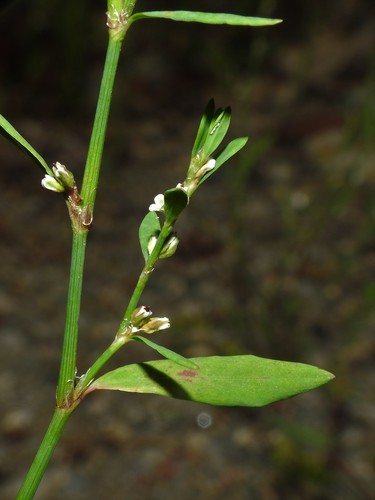
Polygonum ramosissimum Michx. produces erect stems that reach 30 to 100 cm (12 to 39.5 inches) tall, and may occasionally grow as tall as 200 cm (80 inches). Its foliage ranges in color from yellowish-green to blue-green, and its stems branch extensively. Closed flowers grow in clusters of 2 to 3, occasionally 1 or 5, within the upper ocreae of spike-like inflorescences called racemes, which can grow up to 15 cm (6 inches) long. Flowers are most often greenish-yellow, and rarely marked with pink or white. They are borne on pedicels that are longer than the calyx. The calyx measures approximately 3 mm (0.12 inches) long, is divided into 5 segments, and its three outer sepals are longer than its inner sepals. This species produces seeds within fruits called achenes. Typical achenes are egg-shaped, dark brown, around 3 mm (0.12 inches) long, and have a smooth, shiny surface. Achenes formed late in the growing season are larger, ranging from 4 to 15 mm long. The species displays extensive morphological variability. Variation can be seen between early and late season flowers and fruits on the same individual plant, and across different geographical regions. There are multiple forms and two widely recognized subspecies that differ in flower and foliage color: Polygonum ramosissimum subsp. prolificum (Small) Costea & Tardif, and Polygonum ramosissimum subsp. ramosissimum. Across the United States, this species has conservation status listings: it is listed as endangered or extirpated in Maryland, it has been exterminated from Pennsylvania, and it is listed as threatened in New Hampshire.