About Polygonum aviculare L.
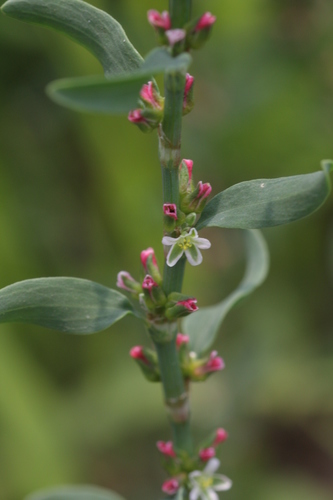
Common knotgrass (Polygonum aviculare L.) is an annual low-prostrate herb with semi-erect, branching stems. As it matures, it forms patches that can reach about 2 meters across. Its leaves are alternate and linear-lanceolate, and they are longer on main stems, where they measure 7-15 mm, than on branches, where they measure 3-5 mm. The entire plant is hairless and green, though it may look mealy and develop whitish leaves when infected with powdery mildew. Leaves, especially those on the main stem, fall off early. Leaf petioles can be up to 5 mm long, or are sometimes completely absent. A translucent papery stipule called an ochrea surrounds the stem above each leaf. Inflorescences grow from leaf axils, and each holds a group of 1 to 6 flowers, each borne on a very short 1 mm pedicel. The flowers are green with white or pink margins, and range in size from 2 to 4.5 mm. Each flower has five overlapping perianth segments, fused into a cup for roughly one third of their length, with 8 stamens and 3 carpels. The fruit is a dark brown nut 1.5 to 3.5 mm long, with 3 concave sides and a dull, leathery sheen. When ripe, the fruit remains enclosed in the perianth. Its seeds require light to germinate, which is why this plant often grows in disturbed soil, where seeds can lie dormant for many years before sprouting. It is native to Eurasia, and is now a widespread invasive species across the world. In the British Isles, it is very common on roadsides and arable ground. This species has fairly modest ecological requirements. Its Ellenberg values in Britain are L = 7, F = 5, R = 6, N = 7, and S = 0, which indicate it prefers average light, moisture, and fertility, neutral pH, and non-saline conditions. Even so, it can sometimes be found growing on beaches, so it must tolerate occasional immersion in seawater. Many insect species feed on common knotgrass. This includes the Knot Grass moth, Acronicta rumicis, which is named after the plant; its larvae feed on the plant's leaves. The UK Database of Insects and their Food Plants records 113 insect species that feed on this plant in Britain. Of these, 10 are beetles, 2 are flies, 8 are Hemiptera (bugs and aphids), and the remaining 93 are Lepidoptera (butterflies and moths).